
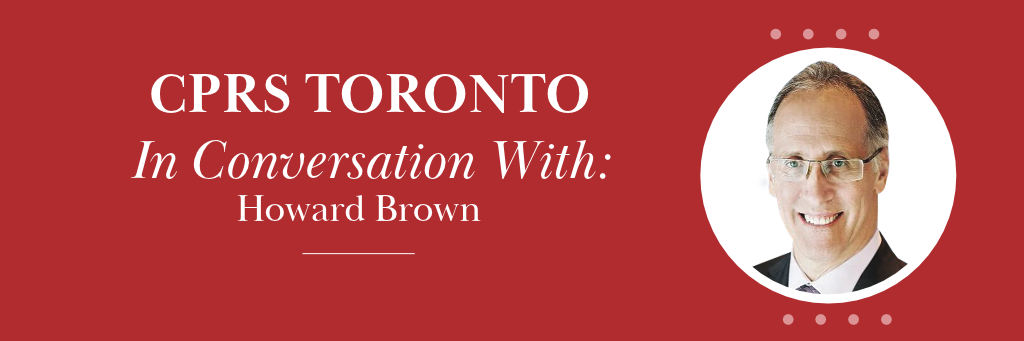
As public relations continues to intersect with politics, business and public opinion, communicators are increasingly expected to anticipate issues, build trust and understand the communities they serve. For November’s In Conversation With blog series, we connected with Howard Brown, president and founder of Brown & Cohen Communications & Public Affairs, the longest-serving Canadian partner in PROI Worldwide.
With extensive experience collaborating with 300 organizations, Howard brings a perspective shaped by public relations, government relations, marketing and an early career in journalism. We spoke with Howard about the evolving relationship between PR and journalism, the importance of proactive issues management, how public opinion influences decision-making and why curiosity, creativity and strong relationships remain essential to the profession.
How has your role as a PR practitioner evolved in recent years?
I think today, you cannot separate business from politics or public opinion. A decision made in a boardroom can quickly become a matter of public debate. We’re inundated with information, but that doesn’t necessarily mean we’re getting a better understanding of what’s happening.
That’s why I think the relationship between public relations and journalism is more important than ever. Newsrooms are leaner, the news cycle never stops, and journalists need people they can rely on for accurate information. It’s not enough to simply put information out there. You have to understand the story, recognize what makes it newsworthy and offer journalists something that genuinely advances their reporting.
And that understanding becomes even more important when you’re dealing with government. Roughly 40% of the marketplace depends on public-sector funding, so understanding how governments make decisions is enormously important. I’ve learned over the years that having the right people in the room isn’t always enough. You can have an excellent proposal, but governments have to consider more than the merits of an idea. You need public opinion with you, and you can’t afford to wait for the parade to form.
What major shifts have you seen in the PR profession, and how are they shaping your work today?
The shift I think about most is the pace at which a local issue becomes a public conversation. Something that once played out over a week now plays out in an afternoon, and the organizations that come through it well are the ones that did their thinking early. That shifts the real work upstream, to well before a story reaches the media. That means taking a proactive approach: getting the facts straight, anticipating where an issue might lead and preparing to answer difficult questions before they’re asked.
The second shift is the way in which people research organizations. Audiences are better informed and more discerning, and they want to know where an organization’s information comes from. Someone weighing a partnership, a purchase or a policy decision will look at everything published about that organization over the years, and increasingly they do it through AI tools that summarize it for them. What has been said about a client, and by whom, carries weight long after the news cycle moves on, so the test for every message is whether it will stand up years from now.
Looking ahead, what trends or changes do you think will define the role of PR practitioners in the future?
With more information at their fingertips than ever before, people are increasingly engaged in the issues that affect their lives. For PR practitioners, that makes our ability to understand what people are thinking, and why, all the more valuable.
That starts in our own communities. Look at our recent municipal elections: people were paying attention to what was happening around them, and we need to be doing the same. Do you know who your city councillor is? Your MPP? Your MP? More importantly, do you know what people in your community are concerned about? In my experience working with government, I’ve learned that even a very good idea does not get far without public support.
Looking ahead, the future of PR belongs to the people who stay curious. They follow the politics, pay attention to what people are talking about, and aren’t afraid to have an opinion.
What is your biggest piece of advice for PR practitioners moving forward?
Throughout my career, from my involvement in politics to building an agency that became Canada’s only representative in PROI Worldwide, I’ve learned that some of the most valuable relationships are with people who see things differently.
I have said since day one, our business is about bringing people and ideas together. But you can’t build relationships only when you need them. You have to invest in them long before there’s an issue on the table.
And I think that lesson extends to business leaders. We need to encourage leaders to get out from behind their desks, explain their decisions and hear what people have to say. Public trust begins with those conversations.
About CPRS Toronto’s In Conversation With blog series
Once a month, the In Conversation With series spotlights voices from across the communications field, featuring leaders and rising professionals who share their perspectives on industry trends, the future of the profession, and their own career journeys. These conversations aim to inspire, inform, and highlight the diverse experiences shaping the future of public relations.
If you would like to share your story or nominate a colleague, please contact us at communications@cprstoronto.com.