
CPRS

CPRS Toronto panel revealed top communication trends for 2018

512 512 Admin

TORONTO – December 15, 2017 – To think of 2018 and what that means for the PR profession can be exciting and frightening. No matter what side of PR you work on, the landscape has been changing at a rapid pace with no end in sight.

At the final Canadian Public Relations Society (CPRS) – Toronto Chapter event of the year on December 4, a panel of CPRS members and thought leaders explored communication trends to watch for 2018. The panel included:

  • Ian Ross, APR, director of communications, Ontario Ministry of Advanced Education and Skills Development (moderator)
  • Tracey Bochner, co-founder and president, Paradigm
  • Bruce MacLellan, founder and CEO, Environics Communications
  • Lauren More, vice-president of communications, Ford Motor Company Canada

The discussion focused on three key trends.

Trend 1: PR practitioners need a new set of skills.
Teams are being built in different ways to solve communications challenges and data is being used more to influence decisions. “This is a great opportunity for PR as it gives you a chance to expand and adapt your skills – like learning about data and metrics as they are becoming extremely important to PR,” said Bruce MacLellan.

Also, with artificial intelligence (AI) being harnessed to provide value to consumers – it will be used by approximately 80 per cent of chat bots in the US next year – engagement with clients and consumers will change. Although there’s a shift to AI, Lauren More believes “one thing that AI cannot do is tell a story that will tug at people’s heart strings and resonate beyond the noise.”

Trend 2: PR is becoming increasingly integrated.
PR campaigns are no longer focused solely on one channel. “When you get an RFP, it’s not the same [as it once was] – you have to include PR, digital, social and experiential marketing,” explained Tracey Bochner.

The panel discussed how it is a misconception that PR is merging into other areas like advertising and marketing. In reality, the practice of PR is expanding and growing into new areas. Clients, for example, no longer want to go to three different agencies for three different things – they want one agency for several services.

Trend 3: PR practitioners need to change how they develop content.
Resource crunches are affecting all companies – budgets are getting tighter and traditional media outlets are decreasing. This forces PR to be strategic in how it’s used to tell meaningful stories.

The panel agreed, more content is not always better. Effective campaigns can no longer rely solely on news releases and earned media efforts. They now require some aspect of paid media, which can include influencers to help further target key audiences.

This CPRS Toronto communications trends panel is the first annual (held at the end of every calendar year), hosted by the local chapters president(s) with panelists made up of thought-leading chapter members.

The Canadian Public Relations Society is a national professional organization focused on establishing and upholding educational and ethical standards in Public Relations. CPRS Toronto is one of the largest local societies with nearly 600 members. For more information, please visit: https://www.cprstoronto.com.

How to write better branded content

700 700 Admin

Written by Diane Begin, CPRS Toronto Co-president

“I would advise anyone who aspires to a writing career that he or she would be wise to develop a thick hide.” Harper Lee

Articles are a powerful tool in public relations for creating user-specific content, encouraging buzz and helping to manage the message.

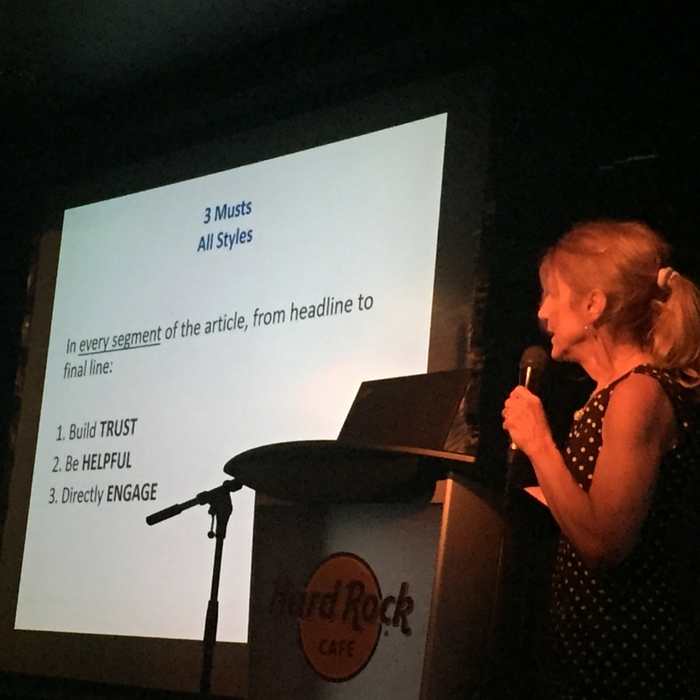
That’s why author and journalist Jane Stokes offered tips at a recent Toronto Canadian Public Relations Society event, to make your branded editorial even stronger.

The approach seeks to match reporter tone through six characteristics:

  1. Cares that readers will trust the information
  2. Cares that readers receive solutions
  3. Remains neutral with the whole conversation; no persuading
  4. Interviews authorities to get opinions
  5. Does not care if audiences take any action
  6. Wants the audience to return

Ultimately, this is accomplished through the acronym Stokes refers to as “T.H.E.”

  • Build TRUST (Is every last word…Impartial? No selling, no cheerleading. Reliable? Sources given. Comfortable? Upbeat, welcoming, not preachy.)
  • Be HELPFUL (Does my wording…Promise solutions? Get straight to the point? Minimal small talk. Make the reader feel satisfied?)
  • Directly ENGAGE (Do all my words…Create a positive/helpful mood? Stimulate thought? Speak directly to the audience? Show empathy? Vary sentence structure, like posing a questions?)

Stokes offered the following headline with T.H.E. at work, to make it stronger.

Before
Top things Canadians love about travel reward programs

After
How to multiply the rewards of travelling

She also offered the following tips for headlines, leads and branding.

HEADLINE TIPS

  • Use the ‘reporter’ voice
  • No unnecessary words
  • Identify the topic exactly
  • Begin your headline with a present-tense verb

LEAD TIPS

  • Don’t repeat the headline
  • Hook the audience
  • Use the ‘reporter’ voice
  • Ask a question
  • Use quick, short sentences
  • No small talk
  • Never begin with boring word “Whether…”

BRANDING TIPS

  • Less is more: 1 brand mention is powerful; 2 exact name mentions are risky; 3 repeats of the brand name are a waste of time (a branded URL is also a brand mention)
  • Quoting an authority allows opinion in the article – a natural path to branding. Quotes give articles a credible Two-Voice quality:
    1. The Reporter Voice: Delivers the topic; guides the article
    2. The Authority Voice: Gives tips (quoted, or tip-list) based on expertise; delivers the branded information

Where are they now?

451 451 Admin

Featuring Erika Manassis, Seneca College Student Representative, CPRS Toronto Student Steering Committee

What did you enjoy most about being on the SSC?

Being on the SSC gave me the opportunity to not only attend student events throughout the year, but to help plan them. I enjoyed acting as liaison between my peers at Seneca College, and my fellow committee members, because it meant I could help make sure that the interests of my classmates were reflected in our SSC events. This made occasions like Passport to PR, and PR 360 much more relatable and applicable to students. It felt great to have a hand in that experience!

As a member of the SSC I was also introduced to non-student members of CPRS Toronto, many of whom I keep in touch with today. The opportunity to mingle with and learn from professionals in the field was invaluable to me as a student trying to find my place in this industry.

And of course – I’ll always be grateful for having met my fellow SSC members through this committee! Though we came from different personal and professional backgrounds, and now work in various fields, it’s nice to know that I have a support system of 15 amazing individuals close by!

Where do you work now, and what do you do?

In April 2016 I joined the team at Cohn & Wolfe Toronto as an Intern. In mid-July I took on the position of an Account Coordinator.

As an Account Coordinator I have a wide variety of responsibilities. From media monitoring, to developing coverage reports, to communicating with bloggers, to pitching stories to media outlets across the country. Every day is different. Most of the portfolios I work on are consumer products, which allows our team to have a lot of fun with story angles, creative pitch notes and media events.

One aspect of my job that I most enjoy is developing relationships with Canadian journalists.  It can be difficult to get to know journalists over email, so I continue to attend CPRS Toronto events each month, where the focus is often on how to communicate with members of the media. At work, I develop these relationships by making phone calls instead of emails to journalists when possible, and doing my best to know what a journalist typically looks for in a story idea.

How do you think CPRS Toronto helped advance your career or get you ready for your current position?

Volunteering with CPRS gave me “real world” PR experience while I was still a student. Continuing to volunteer now that I work at a PR agency offers many opportunities to continue to learn from industry colleagues, and experts in the field. Since joining CPRS Toronto as a student member in September 2015, it has been nothing but a beneficial personal and professional experience!

LinkedIn: https://ca.linkedin.com/in/erikamanassis

2016 CPRS ACE Award PR Campaign of the Year: Edelman for Ontario Association of Optometrists

1920 1441 Admin

2016 CPRS ACE Award Creative Campaign of the Year: Narrative PR for Scotiabank

527 198 Admin

2016 CPRS ACE Award Best in Show Contender: APEX PR for Polysporin

1920 646 Admin

2016 CPRS ACE Award Best in Show Contender: Narrative PR for Bacardi

527 198 Admin

2016 CPRS ACE Award Best in Show Contender: APEX PR for Walmart Canada

1920 646 Admin

2016 CPRS ACE Award Best in Show Contender: Veritas for Stella Artois

1871 563 Admin

What truly makes a gold submission?

1817 871 Admin

ACE Awards Judge, Lauren More, answers that question and shares her insights on the qualities of a gold winning submission

Taking the leap to judging the CPRS Toronto Ace Awards was a natural next step for Lauren More, VP Communications for Ford of Canada. Her six years of judging allowed her to see some of the freshest and most creative campaigns across industries. From helping run the CPRS Toronto mentoring program to ACE Awards judging, Lauren sees volunteering as her way of supporting the communications field.

Lauren shares her insight into creating an award-winning submission with this year’s crop of ACE award applicants:

The most popular categories

While ACE award judges typically judge on a variety of different categories, there are some categories that receive far more entries and are more competitive to place.

“It’s very competitive because it’s kind of the meat and potatoes of a lot of what we do as communicators,” said Lauren. “But the other area that has certainly just expanded exponentially is the social media category.”

The social media category, in particular, has some of the most creative submissions she’s seen.

The most standout campaigns

Lauren notes that often the most memorable and effective campaigns are the ones where “maybe it’s not the sexiest product or the sexiest point of view or the sexiest issue to grab awareness for”. Yet with a creative approach, these campaigns gained a ton of media attention.

While there are some topics that are naturally going to be of more interest to the media, the campaigns she’s enjoyed over the years are the ones where the brand really has to work at it to find something that would be meaningful to their audience.

The challenges to creativity

While it’s increasingly challenging, to come up with new ideas and new approaches, Lauren concedes sometimes there are periods where budgets have been a lot tighter.

“You have to do a lot more with a lot less,” she said, “And you’re still expected to deliver the same type of results – so I think that’s really pushed the level of creativity.”

The ability to sit back

It comes to no surprise that most communicators rarely have time to slow their everyday pace. Lauren explained the ACE Awards provide that perfect evening to do just that with your team and reflect back on your best work.

“We tend to in our jobs and our field to run pretty fast and run pretty hard.” she said, “And I think it’s really worthwhile to stop and take a breath now and then. To acknowledge the work and commitment we put in.”

There are certain things that separate excellence in our field. Lauren believes it’s important as a profession to both recognize and celebrate that.

The extra “oomph”

Key to winning best in show or taking home gold in any given category, Lauren emphasizes the consistency throughout the RACE formula steps. Some of the best submissions, in her opinion took the following measures:

  • The research connects well with the analysis
  • The analysis connects well to the communications tactics
  • A solid evaluation of the results

If you research well you understand what you’re trying to achieve with a communications program. Those winning gold and best in show have that extra dose of creativity, she said.

Lauren also notes past campaigns resonated with people – their key audience – and they told a story, a really good story and “they have that little extra oomph to them.”

Written by: Jessica Chong, Account Coordinator, High Road Communicatons