MEMBERS BLOG

Inside the Classroom: How Digital Learning Is Shaping the Next Generation of Communications Professionals

1024 341 Lois Marsh

Inside the Classroom: How Digital Learning Is Shaping the Next Generation of Communications Professionals

By Samiha Fariha

As Digital Learning Day returns on February 26, it offers a timely moment to reflect on how technology is reshaping not just how we work, but how we learn. For those entering the communications profession today, digital fluency is no longer a bonus skill — it’s foundational. From generative AI to data-driven insight, the tools shaping communications practice are evolving quickly, and classrooms are being challenged to evolve just as fast.

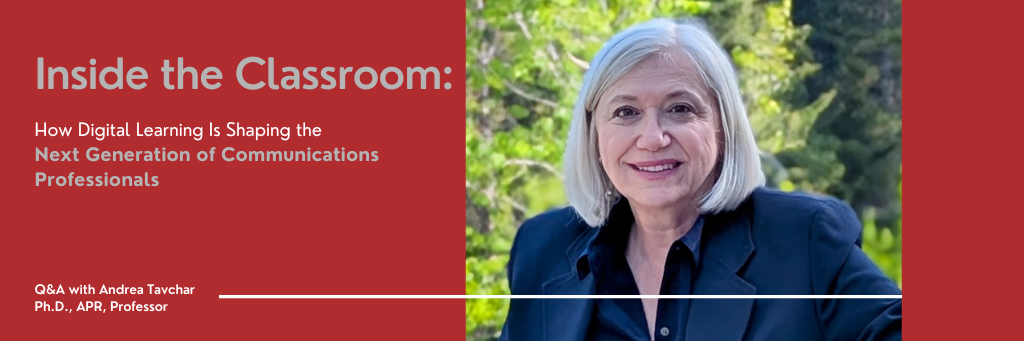
To mark the day, we connected with Andrea Tavchar, Ph.D., APR, Professor in Humber Polytechnic’s Bachelor of Public Relations program, whose work sits at the intersection of education, technology, and the future of the communications profession. Andrea is focused on helping students build strong foundational skills while thoughtfully integrating emerging tools into the learning experience.

We spoke with Andrea about how communications education is responding to generative AI, how data and social listening are changing the way audiences are understood, and why trust, ethics, and lifelong learning remain essential as the profession continues to evolve. From balancing technology with human judgment to preparing students for a rapidly changing industry, here is what she had to share.

From your vantage point in PR education, which emerging technologies are most reshaping the communications profession right now and how is the classroom keeping pace with those shifts?

Generative AI is impacting the practice of PR and, by extension, PR education. We know that the PR industry is embracing generative AI in a variety of ways, including improving productivity, predicting trends and risk detection, summarizing data and drafting content, for example. As a result, it’s important that those of us who teach PR are also incorporating the tools in classroom learning. This is complicated because it’s essential that we also teach core PR skills such as writing, content creation and research. The challenge is how to integrate generative AI in the learning without compromising key skill development.

One way that I have integrated AI into the PR learning process is by teaching students about effective prompt writing, having them generate an AI draft and then working on “humanizing” the content to reflect accurate information, cite reliable sources, add human/authentic anecdotes and insights and to write in a conversational tone. The students are then asked to reflect on the experience of using generative AI in the content creation process.

Other faculty are incorporating AI in other ways, often as a tool to edit content after it was written organically. An important skill we’re all teaching is critical thinking to ensure the gen AI content is free from bias, accurately cites sources and is timely and relevant. These are areas where gen AI can still improve. And these are also ways we can tell if students are overly reliant on gen AI outputs rather than their own research and writing skills.

As AI and automation become more embedded in communications work, what broader implications do you see for strategy, creativity, and ethical decision-making in PR?

When consulting my colleagues in industry, they confirm that generative AI is changing the way they work. They talk about using gen AI for productivity improvements, aiding in media monitoring and analysis, and summarizing data, among other things. They also share that gen AI aids in brainstorming and drafting content. However, the overwhelming message I’m also hearing is that the final draft of any content produced must sound human. And, the act of humanizing content is becoming an important skill, moving forward. A colleague of mine, Yvette Elliott, an AI marketing consultant (among many other things), has a useful checklist she shared with my students that recommends incorporating localized references, real-life anecdotes and conversational language into your writing.

From an ethical perspective, it’s important for AI to be used transparently, with PR practitioners expected to disclose any generative AI use. In the process, practitioners should also ensure that the tool maintains data privacy and avoids bias. Some useful tools include the CPRS and CIPR’s Ethics Guide to Artificial Intelligence in PR, which outlines a decision-making framework to assess ethical risks, including bias, misinformation and consent. Other good resources that I came across while studying for my APR last fall include Luttrell and Wallace’s Public Relations and the Rise of AI and the newest edition of David Meerman Scott’s The New Rules of Marketing and PR, which features a chapter on AI for marketing and PR.

In your experience, how has the rise of data, analytics, and social listening changed the way PR professionals should think about audience insight and engagement?

Since the inception of social networking sites in the mid-2000s, we have seen PR practitioners improving their ability to measure their communication outputs. K.D. Paine’s frequently quoted catchphrase – measure what matters – has guided practitioners to track social media analytics and listen to audience sentiment through online comments. And today, practitioners have elevated their expectations of online content performance, striving for online engagement and community building over vanity metrics. The result has been more targeted and personalized communication that is intended to gain stakeholder trust and improve brand reputation. Generative AI is further challenging practitioners who now need to create content for generative engine optimization, which means being findable for generative AI platforms.

With trust under pressure and disinformation becoming more sophisticated, how can technology be used responsibly to strengthen transparency and authenticity in communications?

What I’m reading and hearing from practitioners today points to the need for organizations to focus on both owned and earned content creation. Producing high quality owned content versus vs large quantities of content can build a pipeline of useful, accurate and reliable content that can be scraped by generative AI platforms. Ideally, this ensures that the gen AI results spotlight the organization in a positive way. I’m also learning that we’re seeing a move from SEO to GEO (or generative engine optimization), which encourages us, among other things, to get third-party endorsements for our content (which is valued by the gen AI platforms). This is obviously easier said than done – and it will be interesting to see if the strategies practitioners employ to accomplish this vary from the traditional news releases and influencer partnerships. The bottom line is that businesses themselves need to ensure that quality content exists to strengthen transparency and reinforce authenticity of their brands.

How do you see collaboration between academia and industry evolving as digital tools and platforms continue to change at a rapid pace?

Through the process of studying for my APR last fall, I realized how much the PR industry values communication theory. CPRS’s APR process showed me that practitioners are expected to embrace theoretical frameworks as learning tools, which inevitably contributes to the greater development of PR as a profession, making it a more strategic practice. In turn, it also equips practitioners to be lifelong learners, and better prepared to face rapidly changing technologies.

In turn, I’ve witnessed how much industry values the academic perspective through their support of our PR students. Industry recognizes the importance of PR training in the knowledge and skills required to be a successful practitioner in the PR profession. Theoretical knowledge can lead to higher levels of strategic thinking through effective research and critical analysis. Understanding theory is important to widen options in professional careers. The industry support we see on our student thesis nights speaks to the degree to which academic background enriches the practice of PR.

Looking ahead, what mindset or capabilities will be most critical for communications professionals navigating the next wave of digital transformation?

As long as practitioners embrace life-long learning they’ll be set for success. Whether that means taking a course, signing up for a webinar, reading a blog or subscribing to a Substack newsletter, practitioners need to keep up with the pace of change. Edelman’s Trust Barometer does a great job providing an annual pulse check to the industry, and many practitioners contribute to the collective learning through insightful LinkedIn posts (for example). I think it’s important to be intentional in your learning – find time in your week or month to follow opinion leaders in your sector and keep in touch with colleagues. Attending the annual CPRS conference can be another way to stay up to speed. Staying current is key and that’s something we teach our students. Another way to be of service is to volunteer as a guest speaker or client in one of our classes. It’s a priceless experience for the students and is a good way to keep you on your toes!

Samiha Fariha is the current Communications Chair on CPRS Toronto’s Board, a Senior Associate at Golin’s Toronto office, and a professor in The G. Raymond Chang School of Continuing Education at Toronto Metropolitan University. She brings a strong focus on media relations, content strategy, and digital communications, informed by her experience in both agency and academic settings.




The PR Playbook for the 98th Academy Awards

1920 1280 Lois Marsh

The PR Playbook for the 98th Academy Awards

By Sanjeev Wignarajah

The 98th Academy Award nominations were announced a week ago and Sinners leads the all-time record with 16 nominations. Last year’s Oscars was one of the strongest. We need to look at how studios leverage marketing campaigns for their respective films to be nominated from the film festival circuit to awards season and what PR firms can learn from them to create campaigns that are unique in their own right.

PESO Model

The PESO Model® is a communications framework created by Gini Dietrich and shared with the industry via Creative Commons. Learn more about the model on the Spin Sucks blog: https://spinsucks.com/communication/peso-model/.

 Earned Media – Festival Buzz

Much of the 10 nominated films for Best Picture at the 98th Academy Awards received Oscar buzz thanks to the press and the Academy Motion Picture of Arts and Sciences voting committee. These reviews perk up interest for Film Twitter, film insiders, and movie goers that see the film at a film festival. Both Letterboxd and Film Twitter go hand in hand as each film gets glowing reviews from the community, which translates to word of mouth and a reason to go see it on the big screen. The same can be said for independent journalists who cover movies.

Shared Media – Social Media Reactions

Long before social media when a movie was great, people would tell their friends and family about it. Flash forward to now, a review can be in the form of a tweet or a YouTube video. Platforms like Letterboxd have changed the way the film industry used to be, not just a digital film diary but as a way to connect with other cinephiles while logging their film reviews. Independent content creators and podcasters specializing in movies would gain access to red carpet interviews and press junkets to interview the cast and crew about the movie.

The key takeaway…social media clippings and online news articles are your new best friend.

Spotlight Strategy

Studios go into the drawing board on how they will campaign a few of their films once the festival circuit is over. Instead of the traditional billboard campaign of years past and somewhat of a full on magazine spread. Studios would allocate a certain budget to spend on the Oscar campaign through different platforms.

The key takeaway is to utilize social media platforms and analytics to track the progression of the campaign from paid media to shared media.

And The Oscar Goes To…

What PR agencies and firms can learn from this is to craft a campaign that is unique and meaningful that ties into their client and to form a story around the message. As social media evolves into content driven with influencers collaborating with brands forming a story around a particular product. Agencies are going through the social media route not only to share their campaign with their respective client. In the post-strike Oscar era where small, independent studios like A24 and NEON Rated are thriving in their filmography winning awards as well as Netflix making ground and big studios like Warner Bros. That is absolute cinema.

Sanjeev Wignarajah is a freelance writer and photographer working with select clients and publications. He has a background in journalism and public relations from Centennial College.    

How to Be Successful in Job Interviews

500 333 Lois Marsh

How to Be Successful in Job Interviews

By Brandon Kish

How am I going to get this job? How am I going to succeed in the interview? These are common questions many people ask, including me. It is perfectly natural to be nervous before a job interview because it is unpredictable what can happen. However, the important thing is to be prepared. There is a lot that needs to take place before interview day. The better prepared you are, the less nervous and more successful you will be.

Here are some tips to succeed in your next job interview:

1. Research Yourself

Think of going into the interview as an audition. You want to show them why you are better than the other candidates. Think about your skills and what you offer that is different from others. Know about your strengths and weaknesses. This shows that you are in tune with yourself and not trying to project perfection. Be able to give clear examples of both; this demonstrates that you understand yourself.

Your personality is something very attractive about you. Be sure to explain why you are interested in this position and industry.

2. Have Questions Prepared

Once the interviewers have asked their questions, you are most likely going to be asked if you have any. Never say that you don’t. That immediately looks like you are not interested in the position. One is not enough, and you don’t want too many. You should have about three questions written down. Think from their perspective too. Would you rather hire someone who keeps showing interest, or someone who just wants to get out of there as fast as possible? They want someone who they feel will be best for their organization’s future success.

Here are some examples:

  1. What would a typical working day be like?
  2. Who will the new employee be reporting to?
  3. What immediate projects or tasks would I be working on?

To practice, anticipate the questions that they may ask you. Research online commonly asked questions about the job position you’re applying for. Preparing your answers will help calm your nerves and give you more control over your answers.

3. Practice

You’re acting. Your big role is to go into that interview and demonstrate that you are the best choice for the job.

Search online for common questions that are asked for your position in job interviews. Then you can even look online for answers for those jobs. Be sure to tailor the answers to your own skills, experience, and the job posting itself.

You want to sound positive but also calm. Your lines do not have to be 100 percent rehearsed. There will potentially be unexpected questions in the interview. Think of it like professional sports. Teams practice before a game, but nothing is like being put into the battle. It is unpredictable, but being prepared will reduce your chances of something negative happening.

4. Plan Your Transportation

You probably hear it all the time: “Don’t be late.” But really, please, don’t be late. That automatically reduces your chances to a minimum of getting the job. Be sure to arrive early. You should perform a dry run; drive, get a ride, or take transportation, etc., to the location at approximately the same time as the interview. This way you know what to expect. You should arrive early to demonstrate that you respect the interviewer’s time and that you are professional. Check for parking and alternative parking locations. You don’t want to show up and become late.

5. Body Language

Slouched shoulders, no smile, and a quiet voice. Wow, it sounds like that person is about to jump for joy. They are so excited for their interview. Not. Remember it like you’re playing a character. You get what you put out. You want to demonstrate to the interviewer and organization that you are happy about potentially working with them. It is important to have open palms and appear receptive. Show those pearly whites as well by smiling. Make them feel good in your presence. The last thing they want is someone who doesn’t bring a positive attitude to the workplace. Remember, they are trying to find someone who, yes, does a good job, but also contributes to the team setting in a professional but positive manner. Keep those arms uncrossed and absolutely no fidgeting. Those show a sense of nervousness or fright. Keep that posture good, as this portrays confidence. If you slouch in your chair, then you’re going to look uninterested and unmotivated.

6. After the Interview

Please remember that the interview doesn’t end when you leave the office. In fact, there are a few more details to keep in mind. First, remember the names of the people you were interviewed by, and if possible, get their email addresses. Later that day, you should send them a thank-you email. This displays professionalism and appreciation for the opportunity.

Your email should:

  1. Be individualized to the interviewer. My gosh, please put the person’s name. Don’t put “Hiring Manager.” If you’re writing a birthday card to your in-law, you don’t write “Happy Birthday Father-in-Law”; you write their name.
  2. Re-emphasize your interest in the position. Show them how you want to work for them. They want to see someone who would enjoy it, not someone passive about it.
  3. Thank them. You wouldn’t believe how often people forget to do this and instead tell them that they are awaiting their call. This person took the time to interview you out of their busy schedule. Please say the words “Thank You” in the email.

You are going against other candidates for positions, so you want to demonstrate why you are the best choice. Nothing is guaranteed. You may have a great interview and not get the job. But you never know what can happen next. Companies sometimes are so pleased with an interview that they might let you know that they have you in mind for another position. I have had this even happen with me. It is better to have a job than to not have a job. Overall, this experience will also allow you to succeed in future interviews because it gives you great practice. Best of luck!

Brandon Kish is an author and administrative assistant in an employment services program. With a background in public relations and communications, he is passionate about helping people achieve their goals and believes in the power of staying positive.


Co-Presidents Message
February 2026

500 250 Lois Marsh

Co-Presidents Message

Happy February. 2026 has been a cold one, hasn’t it? But as we count down the days until this cold frost dissipates, let’s also take time to celebrate this month. February is Black History Month. It should be a time for both reflection and celebration. On the one hand, let’s celebrate the incredible black communicators and journalists we work with every day. Let’s also remember that the playing field was not equal for them, making their accomplishments even more impressive.

Let’s also take time to reflect on our own anti-racism journey. At CPRS Toronto, we have a strict anti-racism policy, but we ask our members to go beyond simply adhering to policies. We all have much to learn. This is a time to listen, to learn, to ask difficult questions about our own conscious and unconscious biases. And, as communications professionals, let’s take time to ensure that our work challenges those biases and promotes a more equal, fair and humane world.

As we move through this month, we encourage you to stay curious, stay connected, and keep leaning into the conversations that matter with your teams, your clients, and each other. We are grateful to be part of such a thoughtful and engaged community, and we look forward to what we will continue to learn together this year.

Warmly,

Andrea Chrysanthou, APR & Erin Griffin

Co-Presidents, CPRS Toronto

Member Spotlight:
Carrie Robinson

150 150 Lois Marsh

Carrie Robinson is a strategic communications professional who specializes in translating intricate concepts into comprehensive, concise, and creative narratives for the broader public. Currently a Consultant at Crestview Strategy, Carrie works at the intersection of strategic communications and politics, helping clients navigate diverse and complex public affairs landscapes.

At Crestview, she values the agency’s unique environment, which offers incredible opportunities for mentorship and serves as an exceptional vantage point to gain hands-on experience across multiple sectors.

Prior to joining Crestview, Carrie honed her expertise in provincial politics, focusing on the high-stakes environment of election campaigns and voter mobilization. Her professional background is diverse, with experiences ranging from international policy research at the Religious Freedom Institute in Washington, D.C., to constituency casework for the ONDP in Niagara Falls, and the specialized wine and tourism industries of Niagara-on-the-Lake.

Carrie holds a Master’s in Political Communication from Goldsmiths, University of London, where she achieved First Class Honours. She also earned an undergraduate degree from Bishop’s University, with a double major in Political Science and International Relations and a minor in Religion, Society, and Culture.

Originally from Niagara-on-the-Lake, ON Carrie maintains a keen interest in the viticulture, hospitality and tourism sectors. As a member of the CPRS community, she is committed to professional growth and values the opportunity to connect with and learn from fellow industry leaders.

Fun Facts

  • A dual citizen, Carrie’s Masters dissertation was entitled “Exploring the Electability Narrative & Media Power in U.S Democratic Party Primaries.”
  • In her free time, Carrie makes jewelry, plays guitar and enjoys a good book.
  • Carrie is an avid traveler and reached over 25 countries by age 25. Her top recommendations are Iceland, the Philippines, Morocco and the Lake District of the UK.
  • Carrie inadvertently started her career in political communications at age 17, when a candid moment of PM Justin Trudeau kayaking up to her family went viral on X.

About CPRS Toronto’s Monthly Member Spotlight

Once a month, the Monthly Member Spotlight shines a light on the people behind our CPRS Toronto community, giving them the opportunity to share their stories, highlight their work, and inspire peers across the public relations and communications field. These features showcase the diverse experiences, career journeys, and personal passions that shape our profession and strengthen our community.

If you would like to be featured or nominate a colleague, please contact us at communications@cprstoronto.com.

CPRS Toronto: In conversation with Zandra Miljan

800 266 Lois Marsh

CPRS Toronto: In conversation with Zandra Miljan

February is a great moment to pause and reflect on how the world of communications is evolving, from faster news cycles to higher expectations for trust and clarity. For this month’s In Conversation With blog series, we spoke with Zandra Miljan, Vice President at Crestview Strategy, about how the role of PR has expanded, what it takes to build trust under pressure, and why sound judgment remains at the heart of effective communications. With experience spanning journalism and strategic advising for leaders in high-stakes situations, Zandra brings a clear, disciplined perspective grounded in results, credibility, and long-term trust.

How has your role as a PR practitioner evolved in recent years?

My role has evolved from leading PR execution to owning how communications drives organizational outcomes.

Earlier in my career, I focused on the core disciplines of public relations: narrative development, media relations, and amplification across earned, owned, and paid channels. That foundation remains central to my work. What has changed is the context in which the work happens and the decisions it informs.

Today, I am accountable for ensuring communications is integrated into leadership decision-making from the outset. I advise executives on when to amplify, when to hold, and how to sequence communications so visibility strengthens credibility rather than undermining it. In an environment defined by constant scrutiny and compressed news cycles, amplification is not optional — but it must be deliberate, disciplined, and aligned with organizational readiness.

At this stage of my career, my role is to align strategic communications across operations, human resources, legal, and policy, and to build the frameworks that allow teams to execute consistently under pressure. That includes setting narrative direction, approving channel strategy, guiding spokespeople, and owning risk in high-stakes moments.

My background in journalism continues to shape this approach. It grounds my judgment in how stories actually move and how quickly momentum builds once a narrative takes hold. As a result, my focus is on ensuring PR is not just visible, but effective — protecting reputation, mobilizing stakeholders, and reinforcing trust over the long term.

What major shifts have you seen in the PR profession, and how are they shaping your work today?

Over the past two decades, public relations has been reshaped by technology, platform fragmentation, and the speed at which information now travels. News cycles have compressed from days to minutes, audiences are decentralized, and stories increasingly break and evolve in real time across digital channels rather than through traditional media alone. As a result, PR practitioners are expected to operate with greater fluency across platforms, stronger data awareness, and faster decision-making — often with incomplete information.

What has shifted more meaningfully, however, is how trust is built and lost. Audiences are more skeptical, less patient, and far more willing to challenge inconsistencies between what organizations say and what they do. Credibility is no longer earned through polished messaging alone, but through visible alignment between words, actions, and leadership behavior.

This has elevated the importance of coherence across the entire communications ecosystem. Internal communications now play a defining role in reputation, as employees are often the first audience, the most credible validators, and, increasingly, the most influential amplifiers. When internal understanding lags external messaging, gaps are exposed quickly and publicly. As a result, PR has become as much about alignment and clarity as it is about storytelling — ensuring organizations communicate in ways that are consistent, authentic, and defensible across every audience they serve.

Another defining shift is the emergence of Artificial Intelligence as both a tool and a risk factor. While AI has increased efficiency in monitoring, analysis, and content development, it has also heightened concerns around authenticity, misinformation, and credibility. This has reinforced the importance of human judgment, ethical standards, and disciplined voice in public relations.

Together, these shifts have made the profession more dynamic and more consequential, underscoring the importance of public relations and strategic communications in helping organizations navigate speed, scrutiny, and trust.

Looking ahead, what trends or changes do you think will define the role of PR practitioners in the future?

The role of PR practitioners will continue to expand beyond communications delivery into judgment, integration, and leadership support — particularly as information environments become more complex and harder to navigate.

Advances in technology, including AI and automation, will further accelerate the pace of communications and increase efficiency across monitoring, analysis, and content development. At the same time, they will heighten expectations around accuracy, authenticity, and responsible use. This will place greater emphasis on human judgment — ensuring tools are used to inform decisions, not replace them, and that organizational voice remains clear, credible, and consistent.

Another defining change will be the continued convergence of internal and external communications. As employees, stakeholders, and the public increasingly experience information simultaneously, PR practitioners will need to ensure alignment across leadership decisions, culture, and messaging. The ability to integrate communications across functions — and to surface risk early — will become even more critical.

Finally, PR will continue to move further upstream. Practitioners will be expected not only to communicate decisions, but to help shape them by bringing stakeholder insight, foresight, and reputational awareness into leadership conversations earlier and more consistently.

Together, these trends point to a future where PR is defined less by volume and velocity, and more by clarity, coherence, and trust — reinforcing its role as an essential leadership function.

What is your biggest piece of advice for PR practitioners moving forward?

Invest as much in thoughtful and strategic judgment as you do in skills.

The tools, platforms, and tactics of public relations will continue to evolve, but sound judgment — knowing what matters, what doesn’t, and when to act — remains the most valuable asset a PR practitioner can develop. That judgment is built through curiosity, ethical grounding, and a willingness to understand the broader context in which communications live.

Equally important is the courage to be honest with clients and leaders. The most effective practitioners are not those who amplify the loudest, but those who can ask better questions, challenge assumptions, and help organizations communicate in ways that are credible, coherent, and aligned with their values.

As the profession continues to change, practitioners who pair technical fluency with integrity, restraint, and empathy will be best positioned to build trust — and to sustain it over time.

About CPRS Toronto’s In Conversation With blog series

Once a month, the In Conversation With series spotlights voices from across the communications field, featuring leaders and rising professionals who share their perspectives on industry trends, the future of the profession, and their own career journeys. These conversations aim to inspire, inform, and highlight the diverse experiences shaping the future of public relations.

If you would like to share your story or nominate a colleague, please contact us at communications@cprstoronto.com.

How Social Media Can Revitalize Cities?

500 333 Lois Marsh

How Social Media Can Revitalize Cities?

By Sanjeev Wignarajah

As you scroll onto Instagram and TikTok feed, you find content creators going to a new restaurant, cafe, or an event either trying out the food or exploring the venue highlighting what they like and dislike and giving an overall review. Content creators have also explored different neighbourhoods and found unique things about it, which is a big boost to small businesses. We’ll use two cities for this case: Toronto and New York City.

Toronto

Toronto is home to so many eclectic and diverse neighbourhoodsthat are unique in their own right. It is even one of the most visited cities that are flocked by tourists. As soon as a new restaurant or coffee shop opens up, content creators go into detail about the food and drinks served with a little ASMR for the food and drink as a feast for the eyes and the mind. Restaurant owners tell their story on the inspiration of the shop and what it means to them and why people should check it out. The reality for small businesses is that they struggle to break even because of rent increases, insurance payments, cost of supplies, etc. It’s important to support local businesses and show love to them.

Another element of content creators highlighting the city is walking tours. Ever curious about a neighbourhood you want to visit based on word of mouth or on social media? Look no further than a virtual walking tour. These content creators walk from one section to another highlighting businesses, changes to the neighbourhood such as construction, historical buildings, etc.


https://www.youtube.com/watch?v=39nunIZYco0

New York City

There’s a lot you can describe New York City. Whether it’s the movies or countless TV shows you see that are set in NYC. Nicolas Heller, a New York-based filmmaker, documents the real New York. It’s people and local businesses that make New York New York. Heller even made a contest for the best New York Accent Contest. Heller’s content is a slice-of-life of what New York is actually like from one borough to the next.

https://www.youtube.com/watch?v=I38KHfXrwrQ

To quote the late Anthony Boudain, “If I’m an advocate for anything. It’s to move. As far as you can. As much as you can. Across the ocean or simply across the river. The extent to which you can walk in someone else’s shoes or at least eat their food. It’s a plus for everybody. Open your mind, get up off of the couch, move.”

Sanjeev Wignarajah is a freelance writer and photographer working with select clients and publications. He has a background in journalism and public relations from Centennial College.

Language Barrier or Embrace the culture – A Guide for International Communicators to Express Yourself Better

500 281 Lois Marsh

Language Barrier or Embrace the culture – A Guide for International Communicators to Express Yourself Better

By Lucy Luc

Every language carries a story. It holds memories, emotions, humour, and a way of seeing the world that cannot be fully translated. On International Mother Language Day, we are reminded that language is more than a communication tool. It is identity, culture, and voice.

For international communicators, language differences are often framed as barriers to overcome. Yet in reality, they can be bridges to deeper understanding when approached with curiosity and respect. The question is not whether accents, phrasing, or cultural habits should be hidden or corrected. The real question is how communicators can express themselves clearly while staying true to who they are.

This is not about changing yourself to sound like someone else. It is about sharpening your voice and embracing it.

Language Barriers Are Human Moments, Not Failures

In today’s global environment, it is normal to work, study, and build relationships with people who speak a different first language or come from a different cultural background. Misunderstandings happen. Awkward pauses happen. Clarifications are needed.

These moments are not signs of poor communication. They are signs of human interaction.

Strong communicators do not aim for perfection. They aim for connection.

Understanding this mindset is especially important for international communicators who may feel pressure to sound native, flawless, or culturally identical to the people around them. True clarity does not come from erasing difference. It comes from navigating difference with intention.

Find Your Voice Before You Adapt It

One of the most overlooked skills in cross cultural communication is self awareness. Before adjusting how you speak, it is essential to understand how you naturally communicate.

Your rhythm, tone, expressions, and storytelling style are shaped by your mother language. These elements are not weaknesses. They are strengths that add depth and personality to your message.

As a communicator, your goal is not to replace your voice but to refine it so others can understand it more easily.

This means choosing clarity without losing authenticity.

For Students Navigating Multicultural Learning Spaces

  • Clarify expectations early: When working on group projects or presentations, openly discuss how your team prefers to communicate, give feedback, and make decisions. This prevents misunderstandings and builds trust.
  • Use clarity over complexity: Choose words that are easy to understand rather than trying to sound “advanced.” Clear communication shows confidence and leadership, especially in academic settings.
  • Ask and invite questions: If something feels unclear, asking for clarification is a strength, not a weakness. Encouraging others to do the same creates a supportive learning environment.
  • Own your accent and language journey: Fluency grows with use. Your accent reflects experience, culture, and resilience. Focus on being understood, not on sounding like a native speaker.

For Professionals Working Across Cultures

  • Prioritize understanding over perfection: In meetings, emails, and presentations, focus on delivering the core message clearly rather than using precise or polished language that may confuse others.
  • Adapt your communication style, not your values: You do not need to change who you are to fit in. Adjust tone, pacing, and structure while staying authentic to your personality and professional identity.
  • Be intentional with humour and idioms: Keep workplace communication inclusive by avoiding sarcasm or culturally specific expressions unless you are confident they will be understood.
  • Confirm key information: For deadlines, locations, or deliverables, double-check understanding. A quick recap can prevent costly miscommunication.

As communicators, our goal is not to erase our differences but to use them as strengths. Language is not a barrier when approached with patience, awareness, and confidence. The more you practice expressing yourself clearly and authentically, the more your voice becomes a tool for connection rather than division.

On International Mother Language Day, remember:
You don’t need to change yourself to be understood. You need to sharpen your voice and embrace it.

Lucy Luc is the current president of the Student Steering Committee and a CPRS Toronto ACE Award–winning student in her final year of Humber Polytechnic’s Bachelor of Public Relations program, where she is completing her thesis.

PR Campaigns That Changed the Industry and How Did They Do that?

1920 1080 Lois Marsh

PR Campaigns That Changed the Industry and How Did They Do that?

By Lucy Luc


Leadership in public relations is rarely about titles or hierarchy. It shows up in ideas that challenge norms, campaigns that spark conversation, and stories that linger long after a launch date. National Leadership Day is the perfect moment to reflect on how PR leadership has shaped the industry through campaigns that changed how brands communicate, connect, and influence culture.

What Leadership Looks Like in Public Relations

PR leadership is the ability to read the moment and respond with clarity and courage. It means understanding audiences deeply, taking creative risks, and aligning brand values with real world conversations.

From 1988 to 2025, the industry’s most successful leaders have proven that the strongest influence comes from authenticity, humor, and a deep understanding of the human experience. Here is how ten iconic campaigns led the way and changed the industry forever.

  1. Nike: Just Do It

In 1988, Nike stopped selling sneakers and started selling empowerment. By featuring both elite athletes and everyday people, they led a movement toward inclusivity that transformed them from a shoe company into a lifestyle icon.

  • The Result: Global sales soared from $877 million to $9.2 billion in just one decade.
  • Leadership Lesson: Lead with a mindset, not a specification.
  1. Pepsi: Is Pepsi OK?

Pepsi turned a “second-place” retail trope into a Super Bowl win. By using Steve Carell and Cardi B to mock the common restaurant question, they showed leadership through self-aware humor.

  • The Result: Flipped a perceived brand weakness into a cultural “vibe.”
  • Leadership Lesson: Tackle consumer skepticism head-on with transparency.
  1. California Milk Processor Board: Got Milk?

This campaign proved that the best story isn’t about what you have, but what happens when you don’t. By focusing on the “deprivation” of missing milk during a snack, they made a staple product unforgettable.

  • The Result: Created one of the most parodied and recognized taglines in history.
  • Leadership Lesson: Find the universal pain point and provide the simple solution.
  1. Dove: Real Beauty

Dove broke the industry mold by ditching professional models for real women. This was a masterclass in social leadership, challenging the beauty industry’s toxic standards and building a foundation of radical trust.

  • The Result: Dove became a champion for self-esteem, massively increasing global brand loyalty.
  • Leadership Lesson: Advocacy is the highest form of brand authority.
  1. Old Spice: The Man Your Man Could Smell Like

Old Spice led the “viral era” by speaking to an audience brands often ignored: the women who buy the products for the men in their lives. The rapid-fire humor of Isaiah Mustafa made the brand relevant to a whole new generation.

  • The Result: A 107 per cent increase in body wash sales within months of launch.
  • Leadership Lesson: Don’t be afraid to change your “who” to grow your “how.”
  1. Coca-Cola: Share a Coke

Coca-Cola proved that personalization is the ultimate driver of user-generated content. By putting names on bottles, they turned every customer into a brand ambassador.

  • The Result: Millions of organic social media posts and a massive spike in sales volume.
  • Leadership Lesson: Give the audience the tools to tell the story for you.
  1. Snickers: You’re Not You When You’re Hungry

By aligning their product with a biological reality—”hangry” behavior—Snickers created a repeatable, global comedic framework that works in every language and culture.

  • The Result: Consistent global growth and a permanent spot in the pop-culture lexicon.
  • Leadership Lesson: Reliability and consistency are the hallmarks of great PR.
  1. GoPro: User-Generated Content

GoPro didn’t hire a film crew; they hired their customers. By curating extreme-sports footage from real users, they built a community-driven brand that feels more like a club than a corporation.

  • The Result: Established GoPro as the definitive “action camera” through peer-to-peer proof.
  • Leadership Lesson: Authentic community beats polished production every time.
  1. Apple: Get a Mac

Apple personified the competition to make complex technology feel approachable. By casting the Mac as the “cool, easy” choice, they led a shift in how the public perceives personal computing.

  • The Result: Solidified Apple’s identity as the user-friendly alternative to the corporate status quo.
  • Leadership Lesson: Humanize the benefit to eliminate the fear of the product.
  1. Heineken: Worlds Apart

In an era of deep political polarization, Heineken led with empathy. By showing people with opposing views finding common ground over a beer, they positioned the brand as a tool for unity.

  • The Result: Widespread critical acclaim and a massive lift in brand sentiment.
  • Leadership Lesson: High-stakes social commentary requires high-level sincerity.

Learning Points From Campaigns That Changed PR

  • Strong PR leadership begins with cultural awareness
  • Emotion drives memorability
  • Simplicity strengthens storytelling
  • Inclusivity builds long term trust
  • Audiences want to participate
  • Purpose amplifies reach

Why These Campaigns Still Matter Today

The PR landscape is louder and more crowded than ever. Yet these campaigns remain relevant because they respected their audiences. They did not talk at people. They invited people in.

Leadership in PR means knowing when to challenge assumptions and when to listen. It means crafting messages that align with lived experiences rather than marketing formulas.

For students, early career professionals, and seasoned communicators alike, these campaigns offer a reminder that influence is built through intention. Impact comes from clarity of vision and confidence in execution.

Lucy Luc is the current president of the Student Steering Committee and a CPRS Toronto ACE Award–winning student in her final year of Humber Polytechnic’s Bachelor of Public Relations program, where she is completing her thesis.

How PR communicate message to Canadian family dynamite

1920 1080 Lois Marsh

How PR communicate message to Canadian family dynamite

By Lucy Luc


Family Day is a moment many Canadians associate with rest, togetherness, and small everyday rituals. For public relations professionals, it is also a reminder that family remains one of the strongest forces shaping how people receive and interpret messages.

Why Family Insight Is Essential for PR Strategy

Every press release, social campaign, and brand activation lands within a deeply personal context. For the vast majority of Canadians, that context is shaped at home. Family dynamics influence everything from core values and spending priorities to how an individual emotionally reacts to a news cycle.

  1. The Power of the “Home Filter”

When a message resonates with a family’s lived reality, it gains immediate credibility. PR campaigns that acknowledge the “shared effort” of modern life (the juggling of schedules, the multi-generational households, and the non-traditional structures) feel familiar and trustworthy.

  1. The Risk of the “Perfect Image”

Conversely, campaigns that rely on “commercial-perfect” imagery, the sanitized, four-person nuclear family in a spotless home, risk feeling disconnected or even alienating. In a landscape where authenticity is the highest currency, perfection is often perceived as a lack of honesty.

  1. A Moment to Reexamine

Family Day invites communicators to pause and look closer. It is an opportunity to reexamine who Canadian families actually are today. By reflecting these true lived experiences, PR professionals can move beyond merely “sending a message” and instead start a meaningful conversation.

What Canadian Family Life Looks Like Today

Recent research from Statistics Canada and the Vanier Institute highlights clear shifts in how families are structured and how they function. These trends are not abstract. They directly affect how audiences relate to brands, organizations, and public messages.

  • Commitment Over Contracts: Canadians are choosing partnership over legal marriage, with common-law families more than doubling from 9.8 per cent to 22.7 per cent since 1991, while marriage rates fell by nearly 10 per cent.
  • The Rise of Solo Fathers: While one-parent households have increased to 16.4 per cent, the gender dynamic is shifting as solo fathers now represent nearly 23 per cent of these families, up from 17 per cent three decades ago.
  • The Return of the Multigenerational Home: Driven by economic necessity and cultural shifts, multigenerational living is Canada’s fastest-growing household type (up 45 per cent), with nearly half of all young adults (45.8 per cent) now living with their parents.

These facts serve as your “evidence” that there is no longer a single Canadian family story.

How Family Dynamics Shape Communication: Moving from Passive Recipients to Active Interpreters

Families do not just “receive” information; they process it through a collective lens. Households operate as shared decision-making spaces where messages are discussed, questioned, and remembered together. Research into family life shows that PR campaigns are rarely viewed in isolation; instead, they are filtered through “home-grown” values and critical conversations.

  • The Household as a Filter: Parents often act as active interpreters of messaging rather than passive recipients, mediating media exposure and helping children decode persuasive intent.
  • Collective Decision-Making: From purchasing choices to attitudes toward social issues, family conversations are the primary forge for brand perception and public narratives.
  • The Rise of Media Literacy: As families become more aware of how media influences expectations and behavior, they are increasingly likely to discuss and question advertising content as a unit.
  • The PR Responsibility: For professionals, this reinforces that oversimplified or “commercial-perfect” narratives rarely hold up in real household discussions. Messaging must respect a family’s intelligence and diversity to avoid creating friction or mistrust.

Family Day as a Moment for Authentic Storytelling

Family Day works best as a storytelling moment when campaigns focus on connection rather than perfection. Canadian families value recognition of real life experiences more than idealized images.

  1. Tim Hortons: “True Stories” & “Come as You Are”

Tim Hortons has perfected the art of the “Quiet Observation.” Rather than showing high-energy family parties, they focus on the small, repetitive rituals that define Canadian family life.

  • The Strategy: Their “True Stories” series uses real-life customer experiences rather than scripted actors. One notable segment featured a family’s daily visit to a drive-thru as their only moment of “normalcy” while navigating a health crisis.
  • Family Day Application: During pandemic-era Family Days, their “Come as You Are” campaign showcased the unpolished reality of home life: DIY haircuts, pajamas, and messy living rooms. It worked because it didn’t ask families to “do” anything except exist together.
  • The Authentic Key: It highlights emotional closeness through the lens of shared routine rather than a special event.
  • Source: ICS Creative Agency Case Study / Zulu Alpha Kilo.
  1. President’s Choice: “Real Mornings”

Loblaws/President’s Choice shifted their storytelling from the “perfect dinner table” to the chaotic morning rush, which resonates deeply with the exhaustion many parents feel.

  • The Strategy: The “Real Mornings” campaign for PC Children’s Charity abandoned professional narration and scripts. Instead, crews filmed the actual morning routines of families with mobility-challenged children and those benefiting from nutrition programs.
  • The Storytelling Shift: It moved from idealized nutrition to essential support. It showed the “shared effort” of a family just trying to get out the door.
  • Why it Resonates: It acknowledges that family life is often a series of hurdles handled together, making the brand feel like a partner rather than just a vendor.
  • Source: Storymasters Case Study
  1. IKEA Canada: “Bring Home to Life”

IKEA’s Canadian campaigns often focus on how a home adapts to the family, not the other way around.

  • The Strategy: Their storytelling focuses on “unfiltered beauty” and “quiet confidence.” Instead of fast-paced montages, they use long, observational shots of everyday moments—like a family clearing clutter together or a “weeknight dinner with a weekend vibe.”
  • Inclusion via Observation: By showing specific, lived-in spaces (a small condo, a multi-generational household), they allow people to see themselves without the brand needing to “define” what a family is.
  • The Authentic Key: It highlights shared effort (cleaning, organizing, cooking) as the primary way families bond.
  • Source: IKEA Canada Campaign
  1. WestJet: “Holiday Heroes”

While often associated with Christmas, WestJet’s storytelling framework is the gold standard for Canadian “Connection” marketing.

  • The Strategy: Their “Connecting Holiday Heroes” campaign focused on people who work during family holidays (healthcare workers, travel staff) to ensure others can be together.
  • The Pivot: For Family Day, this narrative works by shifting the focus from the “nuclear family at home” to the “support network.” It recognizes that family isn’t just who you live with, but who you work for and who supports you from afar.
  • The Authentic Key: It captures genuine, unscripted emotional reactions that feel earned, not manufactured.
  • Source: MOO / WestJet Case Study

Practical Learning Takeaways for PR Professionals

  • Family diversity is now the norm in Canada
  • Assumptions about household structure weaken message relevance
  • Family conversations influence brand perception
  • Ethical and inclusive messaging builds long term trust
  • Research driven storytelling strengthens authenticity

Family Day is a reminder that strong communication starts with understanding. As Canadian families continue to change, PR strategies must evolve alongside them.

Listening to data, social research, and lived experiences allows communicators to create messages that feel grounded and human. When PR reflects reality, it earns attention and trust.

Lucy Luc is the current president of the Student Steering Committee and a CPRS Toronto ACE Award–winning student in her final year of Humber Polytechnic’s Bachelor of Public Relations program, where she is completing her thesis.