
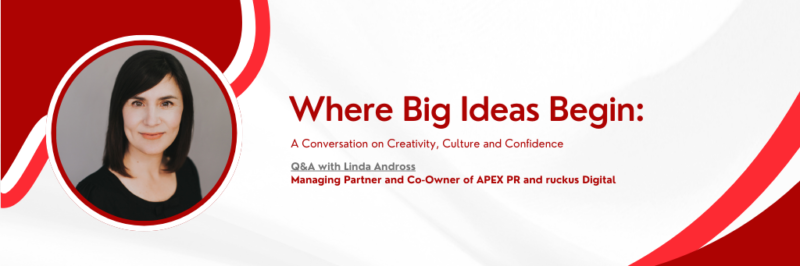
Where Big Ideas Begin:
A Conversation on Creativity, Culture and Confidence
By Anmol Harjani
Every March, International Ideas Month invites us to pause and consider something deceptively simple: everything starts with an idea. The campaigns that shift culture. The platforms that connect communities. The strategies that reposition brands. Before they were decks, deliverables or award submissions, they were sparks, fragile, early-stage thoughts that needed the right environment to grow.
In communications, ideas are our currency. But they’re also our responsibility. A clever hook isn’t enough. A bold stunt without purpose doesn’t move the needle. The best ideas earn their place. They are grounded in insight, shaped by collaboration, sharpened by constraints and built to do a job.
For this year’s International Ideas Month, we wanted to explore what creativity really looks like inside an integrated communications agency, beyond the brainstorm, beyond the buzzwords. We connected with Linda Andross, Managing Partner and Co-Owner of APEX PR and ruckus Digital, to talk about how ideas take shape, how to build teams that feel safe enough to push boundaries, and why creative confidence is something you practice, not something you’re simply born with.
With more than 25 years in the industry and a career defined by innovation, leadership and a clear point of view, Linda has helped shape award-winning work while evolving an agency model that integrates PR, digital, design and social under one roof. Her perspective is grounded, candid and refreshingly practical: creativity is not decoration. It’s the engine.
We spoke with Linda about what makes an idea truly “great,” where inspiration actually comes from, how to pressure-test bold thinking without crushing it, and why the most effective creative cultures balance risk with rigor. Here’s what she had to share.
Creativity often sounds abstract in communications. How do you personally define a “great idea” in PR?
At APEX, everyone is the creative department, so we embed creativity into everything we do to keep it grounded and actionable. A former colleague once said, “you can jump off the CN Tower and that’s a creative idea, but what does it actually do for the brand?” A great idea starts with a real insight, drives the brand story forward, and earns attention by being culturally relevant in the moment. Most importantly, it has a clear point of view and a job to do. It should change how people think, feel, or act. Everything is PR in our world. We don’t limit ourselves to what we think clients expect PR to deliver. We take ownership of the outcome and build ideas that show up meaningfully in cultural, social or technological moments and deliver real impact.
Where do your best ideas typically come from: research, collaboration, constraints, or something else?
All of the above. The best ideas rarely come from one place. I am always looking, listening, and watching what is happening in culture, in media, in business, and in the everyday moments people are actually living. Curiosity is part of the job. But so is perspective. We all get into ruts, especially in this industry, and you have to consciously push yourself out of them. I try to see things through the lens of an audience I might not naturally understand and look for inspiration in unexpected places, not just within marketing echo chambers.
I also believe constraints sharpen thinking. Tight budgets, short timelines, cultural tension, those pressures often force clarity and better ideas. You have to ask, why this brand, why now, and why would anyone care? That discipline is just as important as inspiration.
I push myself to try new experiences, stay uncomfortable, and keep learning. And I surround myself with people who see the world differently than I do. That diversity of perspective at APEX is one of our greatest creative advantages. It protects us from tunnel vision and the dangerous mindset of “we’ve always done it this way,” which is where relevance goes to die.
How do you foster a culture where teams feel safe to experiment and share unconventional thinking?
Lead by example. We bring people in at all levels to collaborate because no one person has “the” idea. It takes a village to develop a spark into a fully formed creative concept that can stand up in the real world. When junior team members see that their thinking is genuinely welcomed at the table, it changes the energy of the room.
We have a high tolerance for risk here, but that doesn’t mean chaos. It means we create space for ideas to breathe before we overanalyze them. As an independent agency, we encourage people to bring forward insights and instincts they believe will resonate for a client’s brand, even if they feel unconventional at first. Then we workshop them rigorously. We ask hard questions. We pressure test. We make them better.
You have to practice taking risks if you want to build creative confidence. Not every idea will land, but every idea should teach you something. Psychological safety matters, but so does excellence. The goal is not just to be brave; it is to be brave and right.
Can you share an example of an idea that looked risky initially but delivered strong impact?
One of our first campaigns for DoorDash was Courageous Conversations, launched during Pride at a moment when connection felt fragile and performative brand gestures were everywhere. We created conversation cards rooted in acceptance, individuality, community, and empowerment, not as slogans, but as prompts designed to spark real dialogue between Canadians.
Originally conceived as an in-person experience focused on building LGBTQ2+ allyship, we had to pivot during COVID to a fully virtual platform. The challenge was not just moving online, it was preserving the emotional depth and authenticity of face-to-face connection. We were clear that if it felt transactional or branded for the sake of optics, it would fail.
At the same time, 69% of Canadians said they engage more with brands that meaningfully address anti-Black racism, discrimination, and the struggles of small businesses during the pandemic. This gave DoorDash a legitimate role to play. The campaign was not just about visibility during Pride. It was about action. DoorDash reduced commission rates, supported Dashers, and used its platform to elevate underrepresented voices.
The response was overwhelmingly positive. The cards sparked conversations beyond the campaign window, and we ultimately crowdsourced new prompts from the community itself. It proved that when brands create space for real dialogue and back it up with tangible support, they earn trust. The work went on to win multiple awards, but more importantly, it demonstrated that creativity and responsibility can, and should, coexist.
What’s your process for turning early-stage concepts into executable strategies?
Turning early-stage concepts into executable strategies is where leadership matters most. Early ideas are fragile. They need room to breathe before they are over-optimized or diluted. So the first step is protecting the core insight. If the insight is strong and culturally relevant, the strategy can scale.
From there, we pressure test. We ask: Why this brand? Why now? What role does the brand have in this conversation? What behavior are we trying to shift? If we cannot answer those questions clearly, the idea is not ready.
We are also rolling out a Creative Scorecard across the agency to formalize this discipline. It evaluates ideas against criteria such as cultural relevance, brand ownership, clarity of insight, business impact, and executional feasibility. It gives teams a shared language for what “great” looks like and ensures we are not just chasing novelty but building work that can perform in the real world.
Once an idea clears that bar, we move quickly into execution mapping. That means defining the narrative arc, identifying earned, social, influencer, and experiential extensions, pressure-testing risk, and aligning against KPIs. Creativity does not live separate from operations here. It is integrated into workbacks, budgets, and measurement from the start.
The goal is simple: protect the magic, build the strategy, and execute with excellence.
How do you balance creativity with client expectations and business realities?
That is the reality of the job, and it can be tough. Creativity without business understanding is decoration. Our responsibility is to deeply understand the client’s business pressures, growth targets, risk tolerance, and internal dynamics before we ever pitch an idea.
Once you understand the business reality, you stop seeing it as a constraint and start seeing it as a brief. That is where the most effective ideas come from. The goal is not to fight business realities, but to design creativity that works within them and elevates them.
We are very clear that ideas have to earn their place. They need to be culturally relevant, brand-right, and commercially viable. That means aligning creativity with measurable outcomes, whether that is shifting perception, driving consideration, increasing store visits, or building long-term brand equity.
The best work proves that creativity and ROI are not opposing forces. When done properly, creativity is the engine that drives business results. Our job is to make that connection undeniable.
What advice would you give communicators who want to strengthen their creative confidence?
Creativity is like a muscle. Use it or lose it. Everyone is creative, even if your expression looks different from someone else’s. The key is practice. If you are unsure, start by weaving creativity into your everyday work. A media pitch can be creative. An influencer brief can be creative. A client email can be creative. The more you frame your work that way, the more confident you become.
But confidence does not grow in isolation. We encourage people to let others see their ideas early. Not just the people they work with every day, but voices from different teams, different disciplines, even different levels. Fresh perspective sharpens thinking. Feedback is not a threat to creativity, it strengthens it.
Creative confidence comes from repetition, exposure, and accountability. The more you practice, share, refine, and improve, the stronger that muscle becomes.
Anmol Harjani is a Client Servicing Manager working with a remote company and a recent graduate of York University’s Public Relations and Communications program. She is especially interested in strategic communications, social media behaviour, and how PR practitioners adapt within a rapidly evolving digital landscape. She currently serves as the Communications Co-Chair on the CPRS Toronto Board.