
PR Practices in Action from Bad Bunny’s Super Bowl LX Halftime Show
By Lucy Luc
The lights dimmed inside Levi’s Stadium. The field shifted from turf to story. In that moment, the halftime show at Super Bowl LX became something larger than spectacle. It became narrative.
Bad Bunny stepped into a performance that reached between 128 and 135 million viewers. That audience size places it among the most watched halftime shows in history. Within days, his music catalog experienced a 470 percent increase in Spotify streams. Those numbers matter. They confirm scale. They confirm engagement. They confirm that attention converted into action.
Yet statistics alone do not explain the impact. The emotional core of the performance centered on identity, culture, and unity. At the center of the stage, a billboard displayed a direct message: “The only thing more powerful than hate is love.” That line shaped how viewers interpreted every image that followed.
Media outlets described the show as a love letter to Puerto Rico. That phrase captures intent. It signals that the performance was designed with narrative clarity. From a public relations perspective, this was structured communication delivered live to over one hundred million people.
Building a Story Through Symbolism
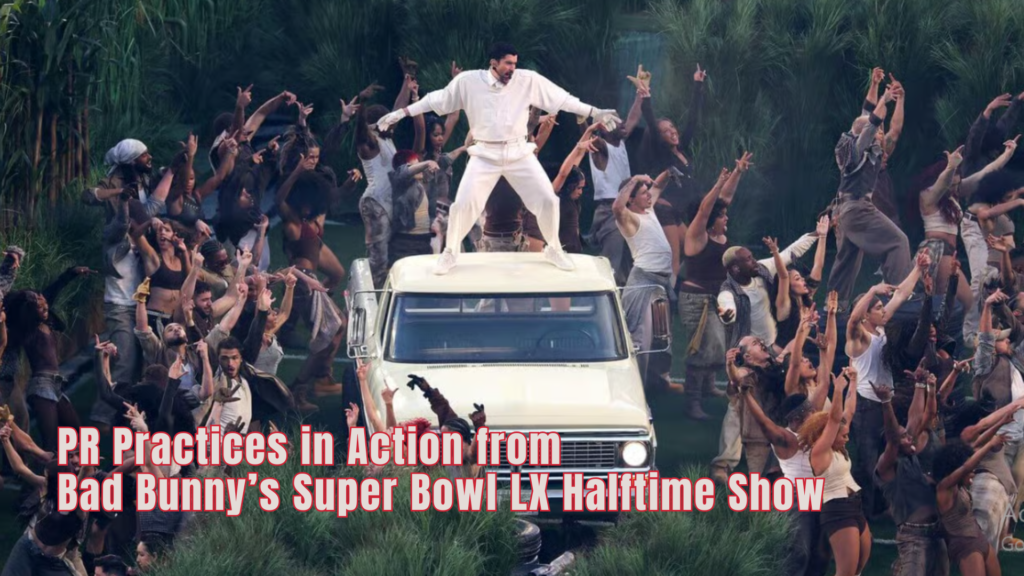
The performance opened in sugar cane fields. This visual choice carried weight. Sugar cane represents Puerto Rico’s colonial history and economic struggle. It reflects periods of forced labor and foreign control. Beginning in that setting grounded the show in history.
As the music moved forward, the stage transformed into scenes of everyday Puerto Rican life. Men played dominos at folding tables. Women gathered at nail stations. Street vendors sold jewelry, tacos, and shaved ice. These were not random props. They were cultural markers.
The images echoed themes from his 2025 Grammy winning album Debí Tirar Más Fotos, which explores memory, home, and belonging. By placing these scenes on the Super Bowl stage, he elevated local life to global visibility.
For public relations professionals, this reflects strategic story architecture. Each visual element reinforced the core narrative. The audience did not receive a lecture about history or politics. They received symbols that carried meaning. Strong campaigns often rely on this principle. Show rather than explain. Let imagery create emotional connection.
When storytelling is layered with intention, journalists have clearer angles for coverage. Viewers have easier entry points into the message. Narrative consistency strengthens recall.
Personal Branding Through Detail
Wardrobe became part of the communication strategy. Bad Bunny wore an all white outfit with a jersey embroidered with the number 64 and the name Ocasio. The number honored his uncle, who once wore 64 as a football player. Ocasio is his family surname.
This detail connected a global stage to personal roots. It signaled humility and loyalty. It told audiences that fame had not erased family identity.
Public relations strategy often focuses on spoken words, yet visual identity shapes perception just as strongly. Clothing, color, and styling influence how a brand is read. When those details align with biography and values, authenticity increases.
Audiences respond to coherence. They recognize when image and story match. Credibility grows when personal history appears integrated rather than attached for effect.
Message Discipline Through Language
The most visible line of the show appeared in bold letters: “The only thing more powerful than hate is love.” The sentence is short. It uses common words. It relies on contrast between hate and love. It acknowledges conflict while offering resolution.
This line did not stand alone in his public messaging. At the 2026 Grammy Awards he stated, “We’re not savages, we’re not animals, we’re not aliens, we are humans and we are Americans.” He continued, “Hate gets more powerful with more hate. The only thing that is more powerful than hate is love.”
Earlier in his career he affirmed his roots by saying, “Yo soy de Puerto Rico.” He also recognized community impact with the statement, “At the end of the day, my success in the United States I owe to the hardworking Latinos who have helped make the country what it is today.”
These quotes reveal message discipline. The same values appear across platforms. Pride in identity. Recognition of community. Emphasis on unity. Repetition builds association. Audiences begin to connect the artist’s name with specific principles.
From a PR perspective, consistent phrasing strengthens brand identity. Clear language travels well in headlines. Short sentences are easily quoted. Memorable statements extend beyond the event itself.
Integrating Social Issues With Control
During the performance of “El Apagón,” dancers climbed electric poles while sparks flew above them. The song references Puerto Rico’s long history of electrical blackouts, including the extended outage following Hurricane Maria in 2017. In a past performance, he criticized the island’s power grid by saying, “Puerto Rico is the only place I perform where I have to install like 15 industrial power generators because I can’t trust the power grid.”
At the halftime show, the imagery referenced this issue without turning into a speech. The symbolism was clear. The pacing remained tight. The message stayed focused.
This reflects a key public relations principle. Address social context without losing narrative control. Audiences can absorb complex issues through music and imagery. Long explanations are not always necessary. Precision protects clarity.
Cultural Heritage as Strategic Positioning
The stage design included a replica of Castillo San Felipe del Morro, known as El Morro, the sixteenth century fortress in San Juan recognized as a UNESCO World Heritage Site. The casita, a pink cement house featured in his album film and residency performances, returned as a central symbol. Celebrities such as Cardi B, Karol G, Pedro Pascal, Jessica Alba, and Young Miko joined him on the porch. Their presence reinforced community support.
Ricky Martin appeared to sing the chorus of “LO QUE LE PASÓ A HAWAii,” a song comparing the colonization of Hawaii to Puerto Rico. The lyrics warn, “They want to take my river and my beach too. I don’t want them to do to you what happened to Hawaii.”
A lighter blue Puerto Rican flag associated with the independence movement appeared during the show. The flor de maga, Puerto Rico’s national flower, influenced costume design.
Each of these elements positioned Puerto Rico as the central character. The island was not background. It was the narrative focus.
Place based branding creates emotional grounding. When communication ties to real geography and history, it gains depth. For PR practitioners, this demonstrates the power of cultural specificity. Broad messages resonate more strongly when anchored in authentic detail.
Key Takeaways for Public Relations Professionals
- Lead with a clear value statement. One strong sentence such as “The only thing more powerful than hate is love” can define an entire campaign and guide all messaging decisions.
- Build the narrative before the spotlight turns on. Every visual element should support a larger story. Staging, wardrobe, music, and symbolism must connect to the same core message.
- Align identity with strategy. Authentic personal details strengthen credibility. When biography and brand message match, audiences trust the delivery.
- Use repetition with purpose. Consistent language across interviews, award shows, and live events builds recognition and reinforces positioning.
- Balance social issues with message control. Address real concerns through focused symbolism and disciplined framing. Stay clear. Stay intentional.
- Design for emotional connection. Audiences remember how a message makes them feel. Emotional clarity increases recall and shareability.
- Think beyond viewership numbers. Measure behavioral impact such as streaming increases, social engagement, and media framing. Action reflects influence.
- Turn moments into platforms. Large cultural events offer rare attention. Strategic messaging can transform entertainment into brand storytelling.
- Anchor visuals in cultural truth. Specific references to heritage and history create depth and strengthen audience identification.
- Connect emotion with intention. Words must carry meaning. Visuals must reinforce values. When identity, language, and symbolism align, communication moves from performance to lasting brand impact.
Lucy Luc is the current president of the Student Steering Committee and a CPRS Toronto ACE Award–winning student in her final year of Humber Polytechnic’s Bachelor of Public Relations program, where she is completing her thesis.