PR networking events Toronto

How to write better branded content

700 700 Admin

Written by Diane Begin, CPRS Toronto Co-president

“I would advise anyone who aspires to a writing career that he or she would be wise to develop a thick hide.” Harper Lee

Articles are a powerful tool in public relations for creating user-specific content, encouraging buzz and helping to manage the message.

That’s why author and journalist Jane Stokes offered tips at a recent Toronto Canadian Public Relations Society event, to make your branded editorial even stronger.

The approach seeks to match reporter tone through six characteristics:

  1. Cares that readers will trust the information
  2. Cares that readers receive solutions
  3. Remains neutral with the whole conversation; no persuading
  4. Interviews authorities to get opinions
  5. Does not care if audiences take any action
  6. Wants the audience to return

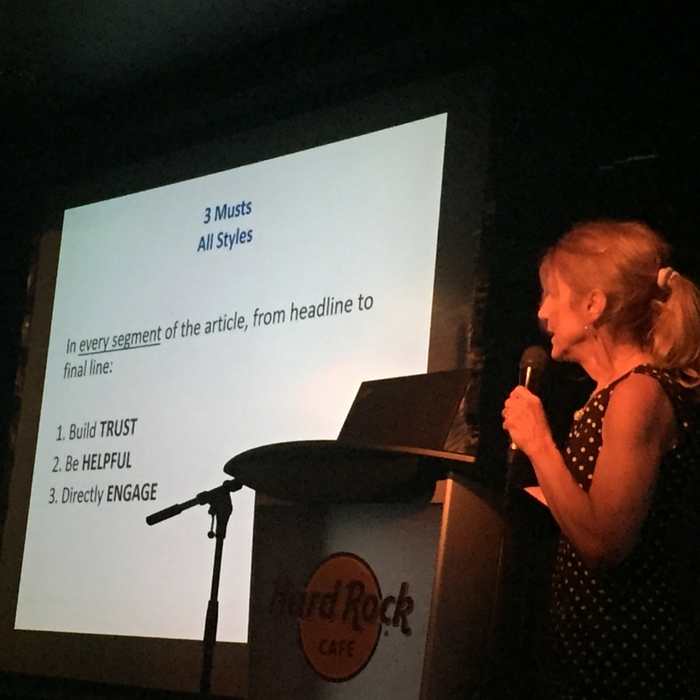
Ultimately, this is accomplished through the acronym Stokes refers to as “T.H.E.”

  • Build TRUST (Is every last word…Impartial? No selling, no cheerleading. Reliable? Sources given. Comfortable? Upbeat, welcoming, not preachy.)
  • Be HELPFUL (Does my wording…Promise solutions? Get straight to the point? Minimal small talk. Make the reader feel satisfied?)
  • Directly ENGAGE (Do all my words…Create a positive/helpful mood? Stimulate thought? Speak directly to the audience? Show empathy? Vary sentence structure, like posing a questions?)

Stokes offered the following headline with T.H.E. at work, to make it stronger.

Before
Top things Canadians love about travel reward programs

After
How to multiply the rewards of travelling

She also offered the following tips for headlines, leads and branding.

HEADLINE TIPS

  • Use the ‘reporter’ voice
  • No unnecessary words
  • Identify the topic exactly
  • Begin your headline with a present-tense verb

LEAD TIPS

  • Don’t repeat the headline
  • Hook the audience
  • Use the ‘reporter’ voice
  • Ask a question
  • Use quick, short sentences
  • No small talk
  • Never begin with boring word “Whether…”

BRANDING TIPS

  • Less is more: 1 brand mention is powerful; 2 exact name mentions are risky; 3 repeats of the brand name are a waste of time (a branded URL is also a brand mention)
  • Quoting an authority allows opinion in the article – a natural path to branding. Quotes give articles a credible Two-Voice quality:
    1. The Reporter Voice: Delivers the topic; guides the article
    2. The Authority Voice: Gives tips (quoted, or tip-list) based on expertise; delivers the branded information

Event post: Building Media Relationships

150 150 Admin

4L9A0308

Authors: Molly Campbell and Natalie D.

On Thursday, Feb. 12 CPRS Toronto’s Student Steering Committee (SSC) welcomed students to the fourth-annual Building Media Relationships event at the Pilot Tavern. A panel of journalists and PR professionals shared insights with attendees. The panel consisted of Jessica Gold, Shaw Media; Robin Smith, H+K Strategies; Heather MacGregor, LCBO; James Bradshaw, The Globe and Mail; Carolyn Jarvis, Global News; Josh Rubin, Toronto Star and Justine Lewkowicz, Newstalk 1010. CNW Group‘s Nadine Tousignant moderated the animated discussion.

4L9A03384L9A0341


The biggest takeaway? “Just be a decent human being,” said Josh Rubin, followed with a laugh from the crowd. Rubin also outlined having a sense of humour, being respectful and valuing the other journalist’s time as being important, which received agreeing nods from the other panelists.

Media relations is taught in PR students’ coursework, but stepping out of the classroom safety net and doing the real thing is daunting. This event gave aspiring students the opportunity to find out what exactly makes news and how to navigate the media landscape.

When asked how newly graduated PR practitioners can avoid “annoying” journalists, every panelist quickly said they didn’t care about experience or age. What matters to them is the story, considering the audience, pitching an interesting angle, timeliness and relevance. The next most important thing is a practitioner’s attitude; being positive, respectful and doing research goes a long way.

4L9A0447

4L9A0368

Here are some key tips from the pros:

1. Ask the right questions – Begin media relations campaigns by asking your client about the results they want, said Robin Smith.

2. No matter what realm you work in, always follow the news – Heather MacGregor suggests setting up Google Alerts and monitoring Cision.

3. Don’t burn bridges – “You’re only as good as the relationships you’ve built, as well as your last job,” said Jessica Gold. Be willing to apologize for mistakes.

4. Don’t be annoying – Justine Lewkowicz warned sending too many emails can put you in a journalist’s bad books.

5. Know your medium – Know “who you’re pitching and why you’re pitching,” said Carolyn Jarvis. For TV interviews, choose someone who reads well on TV. For radio interviews, choose someone with an enticing voice. For print stories, get the point and avoid overusing adjectives.

6. Be open to collaboration – Getting caught up trying to control every element of a story can “turn a collaboration into an adversarial relationship” said James Bradshaw. Let the journalist develop the story. Sometimes the end result may not be exactly what you had in mind, but often through collaboration an even better story can be told.

4L9A0413

Molly outlines some other Dos and Don’ts from the event:

Do make it personal. You stand out from the crowd when a journalists trusts you.

Do meet with journalists outside deadlines to build trust over time.

Don’t use social media as a public forum to criticize journalists.

Don’t take it personally when a reporter doesn’t respond immediately. Media deadlines can vary from every hour to every 30 minutes.

Don’t be a jerk.

Do have phone etiquette. When calling, always ask, “are you busy right now?”


Natalie is a graduate from Seneca College’s Corporate Communications program.

Molly is a student representative on CPRS Toronto’s SSC.

Event post: Work Hard, Play Hard student pub night social

1920 1080 Admin

20141119_211219

On Wednesday, November 19, CPRS Toronto’s Student Steering Committee held its first-ever pub night social. Work Hard, Play Hard invited students and young professionals from around the GTA to join in on a casual night of networking. Students from Centennial, Humber and Seneca were present, as were some young professionals fresh in their careers.

Everyone had a great time and we look forward to hosting another pub night social in the new year!

20141119_211122


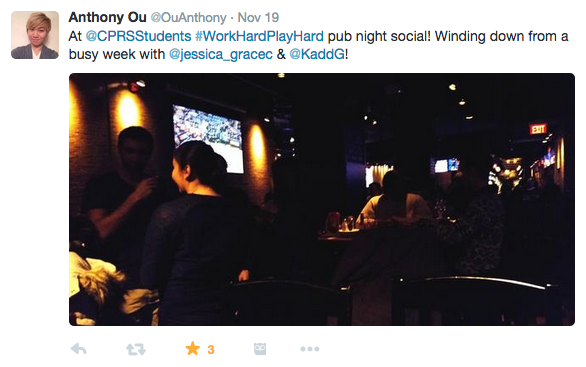
A few choice tweets from the night:

Screen Shot 2014-11-21 at 2.09.27 PMScreen Shot 2014-11-21 at 2.09.39 PM


Screen Shot 2014-11-21 at 2.09.56 PMScreen Shot 2014-11-21 at 2.10.01 PM


Screen Shot 2014-11-21 at 2.09.45 PMScreen Shot 2014-11-21 at 2.09.16 PM


Screen Shot 2014-11-21 at 2.10.07 PMScreen Shot 2014-11-21 at 2.10.30 PM


Screen Shot 2014-11-21 at 2.10.20 PM


I purchased my CPRS membership… now what?

1000 665 Admin

_MG_9470 _MG_9386


You’ve purchased your CPRS Toronto student membership and are ready to take the next steps? Congratulations! You have just made a tangible effort to advance your career in public relations. Joining a professional association has some great benefits, but sometimes it can be difficult figuring out the best way to get started.

  1. Attend as many events as you can

Making an effort to attend events hosted by CPRS Toronto is a great way to get your foot in the door. You will not only hear from industry professionals, but will also have a chance to network with PR professionals and other students.

As a student member, you get priority registration to all student events. This means when tickets first become available you are able to register right away. This year Passport to PR sold out in three hours and even some student members were not able to buy tickets in time so we encourage you to register right away.

Don’t limit yourself to student events only! CPRS Toronto hosts some great professional development events also open to students. The next PD event, Opportunities from the headlines will be held December 2, 2014.

  1. Break out of your shell

When attending events, be sure to speak to people you may not know. Our industry is filled with outgoing individuals who are more than willing to discuss the industry while giving you an opportunity to learn. Professionals who come to events understand your position as a student and know where you are coming from. Other students are likely feeling the same way you are, so don’t hesitate to walk up to someone and introduce yourself! (That includes members on the Student Steering Committee; we’re here for YOU.

  1. Submit content

A new student initiative is our student blog. Every two weeks we have contests for students’ work to be featured. This is a great opportunity to enhance your writing skills, receive feedback and add to your portfolio. (More information to be revealed tomorrow!)

  1. Utilize CPRS Toronto’s resources

Check the job board to see what organizations are looking for in candidates today. Check out the membership directory for industry contacts, and use CPRS Toronto’s library collection at the Toronto Reference Library for more resources.

  1. Volunteer

CPRS Toronto has many opportunities to volunteer. The Student Steering Committee is made up entirely of student volunteers. The ACE Awards, and CEO Award of the Year are also portfolios that look for volunteers each year.

Let us know: What other ways you’ve become involved with the CPRS Toronto society since purchasing your membership?