
NEW PERSPECTIVES

How Brands Can Harness Humor for April Fool’s Day PR Wins

500 249 Lois Marsh

How Brands Can Harness Humor for April Fool’s Day PR Wins

By Lucy Luc

April Fool’s Day presents a unique opportunity for brands to engage audiences with humor, increase visibility, and leave a lasting impression. Playful campaigns and stunts can turn into memorable marketing wins, boosting social media engagement, media coverage, and brand affinity. However, successful humor in PR is about more than just jokes. It requires careful planning, alignment with brand values, and understanding the audience.

Why Humor Works in PR

Humor is one of the most effective ways to capture attention and build emotional connections. On April Fool’s Day, consumers expect lighthearted and playful content, making them more receptive to funny campaigns. Well-executed humor can humanize a brand, making it more approachable and relatable. It can also increase shareability, encouraging audiences to comment, like, and share posts, which helps expand organic reach. Humorous campaigns create memorable moments that stick in people’s minds, reinforcing brand recall long after April 1st.

Case Study Learnings from Successful Campaigns

Several brands have shown how humor can be used effectively in PR campaigns, and their examples provide lessons that any brand can learn from.

Duolingo has become famous for its playful and sometimes mischievous social media presence. For April Fool’s Day, the brand launched a toilet paper product with foreign language phrases called the Bathroom Classroom and introduced the “Duolingo Push” prank. These campaigns were successful because they were entertaining while still being relevant to the brand’s mission of teaching languages. The key lesson is that humor works best when it reflects the brand’s core message. Audiences find content more engaging and shareable when jokes feel authentic rather than forced.

Google Netherlands created the fictitious “Google Tulip,” a tool that supposedly allowed users to communicate with flowers. The campaign featured a realistic lab-style presentation that delighted audiences and went viral. This example teaches that attention to detail and clever presentation can make a humorous campaign feel real enough to be entertaining without misleading the audience. Visual storytelling and creativity can transform even an absurd idea into a memorable PR moment.

Burger King and Subway have also demonstrated the power of playful campaigns. Burger King introduced jokes like the Chocolate Whopper and the Impossible Whopper, while Subway created the Subdog prank. These stunts worked because they combined surprise with absurdity, creating buzz and encouraging social sharing. Sometimes the audience response was so enthusiastic that the ideas influenced real product launches. The takeaway here is that humor can inspire engagement and even innovation when it resonates with the audience.

A playful collaboration between Weetabix and Heinz Beans involved over 140 brands, sparking large-scale social media conversations. This example shows that humor can encourage collaboration and create community engagement beyond a single brand. Engaging multiple partners in a campaign can multiply visibility and generate a fun, collective energy that audiences enjoy interacting with.

Manforce Condoms and Clovia used fictional products to engage audiences and encourage social sharing, showing that humor works across industries. The lesson is that no matter the sector, playful content can break through the noise and attract attention, as long as it is relevant and entertaining.

Lessons for PR Strategy

From these examples, several broader lessons emerge for brands planning humor-driven campaigns. First, understanding the audience is critical. Humor should be tailored to cultural context, interests, and perceptions of the brand. Second, campaigns should align with brand personality to maintain trust and credibility. Third, keeping ideas fun and understandable ensures that audiences enjoy the joke without feeling misled. Multimedia elements like videos, interactive graphics, and mockups can increase engagement and shareability. Finally, brands should be ready to respond if a humorous campaign goes viral. Sometimes what starts as a joke can become a real product or opportunity, just as Subway’s Subdog inspired real customer interest.

It is also important to avoid pitfalls. Humor that touches on sensitive topics, is misleading, or is poorly timed can damage a brand’s reputation. Tesla’s joke about bankruptcy and Volkswagen’s early Volt-swagger campaign show how humor can backfire if not handled carefully. Strategic planning, timing, and clear messaging are essential to prevent confusion or negative perceptions.

April Fool’s Day campaigns highlight how humor can enhance PR by humanizing brands, creating memorable moments, and generating engagement. Successful campaigns combine creativity, brand alignment, and audience awareness. Lessons from Duolingo, Google Netherlands, Burger King, Subway, Weetabix, Heinz Beans, Manforce, and Clovia show that humor can be a versatile tool across industries and formats. Brands that plan thoughtfully, execute cleverly, and engage authentically can transform playful pranks into meaningful marketing wins.

Lucy Luc is the current president of the Student Steering Committee and a CPRS Toronto ACE Award–winning student in her final year of Humber Polytechnic’s Bachelor of Public Relations program, where she is completing her thesis.


Beyond Metrics A New Benchmark for PR Satisfaction

500 281 Lois Marsh

Beyond Metrics A New Benchmark for PR Satisfaction

By Lucy Luc

Public relations has always been about influence, credibility and relationships. Over time, however, the way we define success has become increasingly numeric. Coverage totals, impressions, reach, backlinks, domain authority, referral traffic and sentiment scores now dominate our reports.

There is nothing wrong with this shift. In fact, it reflects growth. As communications professionals, we have worked hard to position PR as a strategic business function. Measurement strengthens our credibility with leadership teams and clients. It allows us to demonstrate alignment with organizational priorities and defend investment in earned media.

Yet as our dashboards become more sophisticated, a new challenge emerges. When measurement becomes the centre of the conversation, meaning can quietly move to the margins.

On OK Day, this blog invites Canadian PR professionals to rethink what satisfaction truly looks like in 2026 and beyond.

What the Industry Taught Us About Measurement

Recent guidance from industry leaders and platforms such as Meltwater highlights the importance of clearly defined KPIs. Active coverage, share of voice, sentiment analysis, earned traffic and domain authority are now considered essential indicators of PR performance.

These metrics offer structure. They create accountability. They help connect communications activity to broader business objectives such as visibility, reputation, sales support or search performance.

They also respond to a common industry tension. Many PR professionals acknowledge that linking communications efforts directly to business outcomes remains one of the most difficult aspects of measurement. That pressure has accelerated the adoption of data driven tools and analytics platforms.

This evolution is healthy. It pushes our profession forward.

The Quiet Risk of Over Measurement

At the same time, numbers alone rarely capture the full influence of public relations.

  • A campaign may generate high reach but fail to convey the intended key messages.
  • A spike in referral traffic may not translate into sustained engagement.
  • A strong share of voice may exist alongside weakening stakeholder trust.

These situations are not failures of PR. They are reminders that visibility and influence are not interchangeable.

Public relations operates in the realm of perception. Reputation builds through consistency, credibility and clarity over time. When we evaluate success only at the campaign level, we risk overlooking cumulative impact.

Redefining PR Satisfaction

If measurement remains essential, what needs to shift is the benchmark.

PR satisfaction in 2026 should reflect whether communications activity strengthens the organization in durable ways. That includes evaluating how well PR aligns with leadership strategy, how effectively key messages are adopted in media narratives and how consistently the brand voice appears across channels.

Professionals can begin by asking more layered questions during reporting cycles.

  • Are our priority themes showing up accurately in earned coverage?
  • Are journalists returning to us as trusted sources?
  • Has executive visibility improved within industry conversations?
  • Is sentiment trending positively across multiple quarters?
  • Are internal stakeholders confident in the communications strategy?

These questions move the conversation beyond volume and toward value.

A Practical Framework for Professionals

For communications leaders seeking a more meaningful evaluation model, consider integrating the following approach into your planning and reporting processes.

1. Anchor every campaign to a defined organizational outcome
Clarity at the outset determines clarity in measurement. Whether the objective is strengthening brand authority, supporting a product launch or managing reputational risk, the goal must be explicit.

Example objectives might include: improving brand reputation, increasing executive visibility, boosting website traffic, or supporting a product launch. Connect KPIs directly to these goals. For example, if the objective is brand authority, track media placements in top-tier publications, sentiment analysis, and key message penetration.

2. Establish a credible baseline
Benchmark share of voice, sentiment and web performance before activation. This provides context for evaluating movement rather than celebrating isolated spikes.

  • Track metrics like share of voice, website referral traffic, social engagement, and sentiment.
  • Record qualitative insights such as journalist familiarity, coverage depth, and message accuracy.
  • Resource: Google Analytics (GA4) can help track referral traffic and engagement patterns before and after campaigns.

3. Prioritize quality indicators
Analyze the depth and accuracy of coverage. Assess prominence within articles. Review how often key spokespeople are quoted directly. These qualitative signals often reveal more about influence than sheer volume.

  • Assess whether key spokespeople are quoted directly.
  • Track if coverage appears in high-authority outlets with strong domain authority.
  • Measure if the messaging aligns with your intended key points.
  • Resource: Tools like BuzzStream help track backlinks, outreach success, and domain authority for qualitative evaluation.

4. Track trends over time
PR is cumulative. Quarterly or annual comparisons provide stronger insight than single campaign summaries.

  • Compare quarterly or yearly data for sentiment, share of voice, or media visibility.
  • Identify patterns in engagement, peak coverage days, or recurring mentions to inform future campaigns.
  • Resource: Platforms like Talkwalker offer social listening and trend analysis for deeper audience insights.

5. Translate metrics into business language
Executives rarely need a list of links. They need interpretation. Explain how increased share of voice shifts competitive positioning. Clarify how backlinks from high authority publications support long term SEO growth. Connect sentiment trends to reputational resilience.

  • Show how increased share of voice strengthens competitive positioning.
  • Explain how backlinks from high-authority sites enhance SEO and drive sustainable traffic.
  • Connect sentiment trends to reputational risk or resilience, rather than just impressions.
  • Resource: PR Newswire’s reporting and analytics tools can help communicate the ROI of earned media in clear business terms.

6. Incorporate Multi-Channel Measurement
Modern PR happens across print, digital, social media, podcasts, and influencer networks. Measure not only media coverage but also engagement, referral traffic, and conversation across channels.

  • Monitor social engagement with likes, shares, comments, and mentions.
  • Track referral traffic from coverage and backlinks to measure lead generation.
  • Include AI-powered insights to analyze sentiment and identify trending topics.
  • Resource: Meltwater and Cision provide multi-channel media monitoring for comprehensive reporting.

By following this framework, communications professionals can evaluate PR impact not only through numbers but also through meaning, influence, and long-term strategic alignment. The key is to combine hard metrics with qualitative insight, ensuring that your reports communicate real organizational value while keeping the human element of PR front and center.

Lucy Luc is the current president of the Student Steering Committee and a CPRS Toronto ACE Award–winning student in her final year of Humber Polytechnic’s Bachelor of Public Relations program, where she is completing her thesis.

Pet PR Done Well: Building Loyalty Among Puppy Owners

500 281 Lois Marsh

Pet PR Done Well: Building Loyalty Among Puppy Owners

By Lucy Luc


The global pet industry is booming. From luxury pet foods and veterinary innovations to celebrity pets with millions of followers, animals are no longer just companions. They are also at the heart of massive markets and cultural movements. With an estimated $320 billion global pet care market projected by 2030, companies, shelters, nonprofits, and even influencers are competing for attention. That’s where Pet PR comes in. At its best, pet-focused public relations doesn’t just sell products; it tells stories that touch emotions, mobilize communities, and build lasting loyalty. Unlike other industries where messaging is rational, pet PR taps into something primal: our deep emotional bond with animals. In this piece, we’ll examine two examples of pet PR done exceptionally well, campaigns that fused creativity, strategy, and emotion to achieve measurable impact.

The Foundations of Great Pet PR
Before diving into the examples, it’s useful to outline what makes a campaign in the pet sector stand out.

Emotional Storytelling
Pet PR thrives when it leverages the natural emotional connection between humans and animals. Whether it’s highlighting a rescue dog’s transformation or showing the lengths owners go to for their pets, the best campaigns hit an emotional chord.

Authenticity
Today’s audiences, especially pet owners, are skeptical of overt sales tactics. Campaigns that feel gimmicky or exploit animals often backfire. Success depends on sincerity. A product or cause must truly add value to pets’ lives.

Shareability
Animals dominate social media. More than 65% of internet users follow at least one pet account. A strong PR campaign is designed to spread organically. Videos, memes, or user-generated content often outperform traditional ads.

Integration with Larger Trends
The most effective campaigns tie pet care into larger cultural conversations such as sustainability, wellness, digital culture, or luxury.

Case Study One – The “Dreamies Cat” and Viral Snack Attacks

Background
Dreamies, a cat treat brand owned by Mars Petcare, faced the challenge of standing out in an oversaturated pet snack market. Cats often do not get the same spotlight as dogs in advertising, so Dreamies needed something bold to capture both cat owners and a mainstream audience.

The Campaign
In 2011, Dreamies launched the “Cats Go Bonkers for Dreamies” campaign in the UK. The premise was simple but genius: cats will do anything for Dreamies treats. Instead of traditional commercials, they released a series of humorous, exaggerated videos showing cats breaking through walls, clawing through bags, and even tackling owners in pursuit of Dreamies.

PR Execution
Humour served as the hook rather than sentimentality. Clips were short and perfect for YouTube and Facebook. The bright yellow packaging was featured heavily, making the product instantly recognizable. Dreamies later placed giant vending machines in shopping centers where people could press a button to release hundreds of treats to swarming cats.

Impact
The videos were viewed millions of times, sparking memes and parodies. Dreamies saw a double-digit sales increase in the UK and expanded the campaign internationally. The brand became a cultural reference, with memes often citing “cats going crazy for Dreamies.”

Why It Worked
The campaign was relatable and funny, hitting internet humour culture at the right time. It created a distinct brand identity that separated Dreamies from competitors and showed that humor and culture can make even a small cat treat brand a global phenomenon.

Case Study Two – The ASPCA “Angel” Dog and Cause-Based Pet PR

Background
On the nonprofit side, the ASPCA’s “Sarah McLachlan Angel” campaign launched in 2007 and had lasting cultural impact. Animal welfare groups were struggling to get attention as millions of animals were being euthanized each year. The ASPCA needed a powerful way to break public indifference.

The Campaign
The commercial featured Sarah McLachlan’s haunting song “Angel” over slow-motion footage of abused dogs and cats. McLachlan herself appeared, softly urging viewers to donate.

PR Execution
The campaign used a raw emotional appeal. Celebrity involvement added credibility and star power. The rollout included TV, direct mail, online video, and partnerships. The call to action encouraged viewers to donate monthly to the “founder’s circle.”

Impact
The campaign raised $30 million in the first two years and became one of the most recognized PSAs in American history. ASPCA’s brand recognition skyrocketed, establishing it as a leading animal welfare organization in the U.S.

Why It Worked
The campaign tapped deep empathy for suffering animals, making donating feel urgent and personal. The combination of music, visuals, and clear action created a powerful emotional impact.

Broader Lessons in Pet PR Done Well

Successful pet PR campaigns often share some common principles that go beyond individual brands or products. Timing is key: understanding current cultural trends, social media habits, and audience interests can make a campaign feel relevant and shareable. The choice of medium also matters. Whether it’s short-form video, social media posts, email, or traditional media, the platform should align with the message and how the audience engages with pets online.

Emotion remains the strongest driver of action. Campaigns that make people feel joy, empathy, or excitement are more likely to create loyalty and engagement. Authenticity is essential: audiences respond to campaigns that genuinely support pets’ well being rather than those that feel overly commercial. Finally, successful campaigns often connect to larger cultural or social trends, whether that’s sustainability, wellness, humour, or digital culture, helping the campaign resonate beyond the immediate audience.

Lucy Luc is the current president of the Student Steering Committee and a CPRS Toronto ACE Award–winning student in her final year of Humber Polytechnic’s Bachelor of Public Relations program, where she is completing her thesis.

OWNERSHIP: A STRATEGIC FRAMEWORK FOR CAREER REINVENTION IN COMMUNICATIONS

800 533 Lois Marsh

OWNERSHIP: A STRATEGIC FRAMEWORK FOR CAREER REINVENTION IN COMMUNICATIONS

By Matthew Celestial

The communications industry is not disappearing. It is restructuring quickly. Across Canada and globally, the last several years have delivered sustained workforce contraction across media, technology, advertising and corporate communications. In Canada, the unemployment rate reached 6.1 per cent in 2024, with volatility in professional, scientific and technical services, according to Statistics Canada. At the same time, artificial intelligence has accelerated content production, compressed timelines and reshaped how organizations define value. The World Economic Forum reports that 44% of workers’ core skills are expected to change within five years.

For professionals who have been impacted by job cuts, or who feel stalled, this moment can feel personal. Our work is tied to reputation, visibility and momentum. When that is disrupted, identity can feel disrupted.
But disruption is not a verdict. It is a signal. This is not the end of the profession. It is its evolution.

If you are currently in the middle of a job transition, and finding the hunt for your next role difficult, I’ve designed a framework to help you:

O — ORIENT YOURSELF

Before rewriting your résumé, recalibrate your trajectory.

Career disruption creates psychological noise. Research from the American Psychological Association shows uncertainty activates stress responses that narrow decision-making and increase reactive behaviour. In practice, that means over-applying, underselling or scrambling without clarity.

Where are you coming from? What consistent strengths define your work? Where are your learning gaps? Where do you realistically want to go next, and why? Human resources leaders consistently note that candidates with articulated direction are perceived as more confident and lower risk. Orientation is not reinvention.

W — WRITE YOUR STORY

You will be asked to tell your story repeatedly. Master it.

Structure it in three movements: foundation, evolution, direction. Explain how your early work shaped your expertise. Identify inflection points that expand your scope. Connect your next move logically to your accumulated experience. Recruiters are looking for coherence. They want progression, not randomness. Own your narrative before someone else defines it.

N — NAME AND SHAPE YOUR BRAND

Your personal brand is not self-promotion. It is the foundation of your career.

Audit your digital footprint. Update your headshot. Refine your LinkedIn summary. Remove dated language. Clarify your positioning. Research on hiring behaviour shows that hiring managers establish first impressions within seconds. Inconsistent messaging creates doubt. Consistency builds trust. Professional presence tells the market how seriously to take you.

E — EXPAND YOUR CAPABILITIES

Communications now intersects with analytics, AI tools, executive advisory and digital ecosystems.

The World Economic Forum identifies analytical thinking and technological literacy among the fastest-growing skill demands globally. The most competitive professionals today can interpret performance data and translate it into narrative insight, use AI strategically rather than mechanically, advise senior leadership on reputation and understand social listening and performance metrics. You do not need to master every emerging tool. But literacy in adjacent domains demonstrates adaptability.

R — REFINE YOUR CRAFT

AI can generate content. It cannot replicate judgment, lived expertise or strategic nuance.

Write regularly. Publish analysis in your field. Develop a portfolio that reflects range and technical precision. Study journalists covering your beat and observe how they build authority. Strong writing signals strong thinking and expertise in your desired field. That currency does not depreciate. It becomes valuable over time.

S — STRENGTHEN YOUR NETWORK

Networking should not begin at the point of crisis.

Engage reporters thoughtfully. Participate in industry conversations. Attend professional events. Contribute to associations such as CPRS Toronto. Volunteer where possible. Research on professional networking shows sustained, low-pressure engagement builds trust more effectively than transactional outreach. Be known for your perspective, not just your availability.

H — HONE YOUR PRESENCE

Communications professionals are often public-facing — presenting to clients, advising executives, managing crisis scenarios.

Learn to establish your presence in all spaces. Practice responding to difficult questions. Simulate high-pressure scenarios. Record yourself. Refine clarity and composure. Presence is not charisma. It is establishing a calm authority under scrutiny. Hiring managers recognize it immediately.

I — INTEGRATE ADJACENT SKILLS

Broaden your toolkit deliberately.

Develop literacy in AI prompt strategy. Learn basic design principles. Familiarize yourself with analytics dashboards. Consider learning a second language. Understand event logistics. Study campaign measurement frameworks. These skills compound. They expand the scope of what you can confidently lead.

P — PROTECT YOUR WELL-BEING

Job searching can be destabilizing.

Prolonged uncertainty increases stress and impairs executive function — the very capacities required for interviews and negotiation. Build structure into your days. Set defined job-search hours. Move your body. Seek community. Maintain routine. Resilience is operational. You cannot project confidence from depletion.

As you search for your next role, don’t forget to continue participating within the community. If you are between roles, remain active: write, mentor, volunteer, speak or offer pro bono support aligned with your values. While your employment status may shift, your professional identity does not have to. The strongest repositionings and self-discovery occur when professionals continue contributing during transition.

The job market is evolving, and we are seeing this affect communications professionals. The OWNERSHIP Framework strives to help professionals thrive to think strategically, write with distinction, embrace technology without losing humanity and build authentic networks grounded in credibility. This framework isn’t a “job-search guideline,” it is designed to help our community establish a discipline for long-term relevance in the job market. Communications professionals understand narrative, reputation and resilience better than most. It is time to apply those principles to ourselves. Above all, let this be a gentle reminder to colleagues that your role may have ended but your expertise did not.

Matthew Celestial is a Publicity Director, Animation & Interactive Entertainment at MCPR, a Statement Worldwide Company, and currently serves as Treasurer of the CPRS Toronto Board.

2026 Milano Cortina Winter Olympiad Post Mortem: How The Winter Games Are Having Its Social Media Moment and Attracting New Fans?

800 534 Lois Marsh

2026 Milano Cortina Winter Olympiad Post Mortem: How The Winter Games Are Having Its Social Media Moment and Attracting New Fans?

By Sanjeev Wignarajah

The 2026 Milano Cortina Winter Olympics… uniting the world of two weeks of competition in the Italian winter. How can you not be romantic about Milan? The food, the mountainous landscapes, fashion, the arts, and much more. While the Winter Olympiad may be over. People are still buzzing about it from the drama, the golden memories, to the controversy.

Memes and Social Sentiment

The 2026 Milano Cortina Winter Games provided a lot of memes for everyday life with or without context. There are a few that stood out. One of them was Canadian curler Marc Kennedy getting into a heated and profane argument with Swedish curler Oskar Eriksson over allegations of cheating. While people perceive Canadians as nice and polite. When it comes to competition, “And I took that personally,” Michael Jordan.

Photo Credit: Mr Keeper

Another iconic meme comes from Spanish figure skater Tomas Guarnino Sabate. His unusual routine involves dressing up like a Minion from the Despicable Me franchise and dancing to the Minions soundtrack, which definitely raised eyebrows and laughs.

The cherry on top is Tate McRae’s ‘Y’all know I’m Canada down’ meme. The Calgary-based pop artist appeared in NBC’s Olympic promo, which drew heavy backlash over the ad appearance despite being a Canadian and the strained Canada-U.S. relations. She responded with the famous meme, which spawned all over social media for all things Canadiana evoking Canadian pride from pop culture to everything in between.

The Drama

Spill the tea… as the kids say these days. One of which comes from Norwegian biathlete Sturla Holm Laegreid confessed that he cheated on his girlfriend on live television after winning gold in 20km individual biathlon.

The Controversy

Canadians are still not over the United States Men’s National Olympic hockey team winning gold only to get a video phone call from President Donald Trump congratulating them and sending an invite to the White House and later appearing at the State Of The Union address.

Even FBI Director Kash Patel was seen partying in the locker room with the players. From a PR perspective, it adds salt to the wound given what the USA is going through during Trump’s second presidency. Canada was the better team in the Gold Medal Game. They played with heart, pride, and passion.

Closing Ceremony

The Milan Cortina Winter Olympiad has garnered a lot of interest thanks in part to increasing viewership and social media. Some people are saying that the Winter Olympics are better than the Summer Olympics because of how athletes are willing to survive and compete under the harshest conditions.

Arrivederci Milano Cortina. Bonjour le French Alps in 2030.

Sanjeev Wignarajah is a freelance writer and photographer working with select clients and publications. He has a background in journalism and public relations from Centennial College.

Representation, Belonging and the Power of Being Seen

800 266 Lois Marsh

Representation, Belonging and the Power of Being Seen

By Anmol Harjani

February marks Black History Month, a time that carries different meanings for different people. For some, it’s a time to learn. For others, it’s a time to celebrate. And for many, it’s both, a moment of reflection, recognition and importantly, responsibility.

This month, we connected with Jodi Smith-Meisner, Head of Communications at Schneider Electric Canada. With more than 15 years of experience in public relations, executive thought leadership and internal communications, Jodi has built a career centred on shaping narratives and aligning communications with business transformation.

In our conversation, she reflects on what Black History Month means to her personally, why it’s important to recognize Canadian trailblazers like Jean Augustine, how representation in leadership still shapes career journeys, and why true allyship requires action, not just words. From mentorship to owning your place at the table, here’s what she had to share.

Black History Month was founded in 1926 by Carter G. Woodson to ensure Black stories and contributions were recognized and remembered. What does Black History Month mean to you personally, and how has its significance evolved throughout your career?

Black History Month in Canada was actually founded by Dr. Jean Augustine, the first Black Canadian woman elected to the House of Commons, and I think it’s important to note this, because we often focus on American Black history and don’t give enough credit to the Black Canadians who have paved the way. I had the pleasure of hosting a fireside chat with Dr. Augustine this Black History Month, and it was such a profound and moving moment for me. Black History Month is a time for recognition and celebration. It’s also a time when we have everyone’s attention — an opportunity to invite people to listen and learn.

As Head of Communications for Schneider Electric Canada, how do you view the role of communications leaders in shaping more inclusive narratives inside organizations and in the stories companies tell publicly?

We are the storytellers of the organization, so it’s our role to ensure we are being inclusive in our storytelling. We host company town halls, we select spokespersons for media interviews — having inclusive representation, wherever possible, matters. The stories we choose to tell, and whose voices we amplify, shape culture from the inside out.

Looking back on your journey into communications, were there particular mentors, moments, or experiences that helped shape your path and leadership style?

I had an exceptional leader early in my career who really took me under her wing and shaped so much of how I approach my role today. I consider myself lucky to have worked with such a top-tier communications professional so early on. She was always polished, professional, and commanded tremendous respect throughout the organization. She supported me enormously in the early years and often put my name forward for opportunities. Sarah Borg-Olivier, thank you — I carry your influence with me every single day.

Representation in leadership still matters. What has your experience been navigating senior leadership spaces, and what changes have you seen in the industry over time?

I am seeing more people of colour in leadership roles — but it’s still not enough, and the progress has been slow. I am a firm believer that representation matters. Early in my career, I didn’t see anyone who looked like me at the leadership table, and I would be lying if I said that didn’t affect me — it absolutely did (and it still does today, from time to time!). It was a constant reminder that I was different, and that I would have to really stand out to get to where I wanted to be.

Black History Month is both a celebration and a call to action. From your perspective, what does meaningful allyship and long-term commitment to equity look like in a corporate environment?

It means seeing me for me — for what I bring to the table — and helping me get into rooms that are hard to get into. A lot of leaders talk the talk, but when push comes to shove, they don’t walk the walk. They hesitate, afraid of how it might look, and they step back. Having a leader who is a true ally in your corner can significantly change the course of your career.

Schneider Electric operates in sectors like energy, automation, and sustainability. How can companies in traditionally technical or industrial fields ensure diverse voices are heard and valued?

At Schneider Electric, we operate on the principles of inclusion and care — it’s embedded in how we work and how we treat one another. I believe if more organizations genuinely adopted this model, it would make a tremendous difference. Inclusion can’t be a side initiative; it has to be part of how a company operates at its core.

For young Black communications professionals or students considering this field, what advice would you offer about building confidence, networks, and influence?

First, I would tell them that while great mentors, allies, and networks are invaluable— ultimately, your career is yours to make. Your mentors and network are there to support you, but this is your journey and you have to take ownership of it. Will it be harder for you than most? Yes. But hard doesn’t mean impossible.

On building confidence: if they let you into the room, you deserve to be there. Don’t second-guess yourself or let imposter syndrome take over. I’ve started telling myself, “I belong in every room I walk into.”

Finally, beyond February, how can communications professionals continue amplifying Black voices and stories in ways that feel authentic rather than performative?

Be inclusive — consistently and intentionally. Take a close look at what you’re sharing and ask yourself: does this truly represent the diversity of our country? Start with an audit — look at the photos on your company’s website, brochures, and social channels. Is it a diverse and accurate reflection of who we are? Inclusion should be the standard.

Anmol Harjani is a Client Servicing Manager working with a remote company and a recent graduate of York University’s Public Relations and Communications program. She is especially interested in strategic communications, social media behaviour, and how PR practitioners adapt within a rapidly evolving digital landscape. She currently serves as the Communications Co-Chair on the CPRS Toronto Board.


Beyond the Title: Women in Communications on Leadership, Growth and Impact

940 788 Lois Marsh

Beyond the Title: Women in Communications on Leadership, Growth and Impact

By Anmol Harjani

Every year on March 8, International Women’s Day recognizes the achievements of women across industries and communities worldwide. It is a moment to celebrate progress, acknowledge challenges, and spotlight the voices shaping the future.

In communications, leadership does not follow a single path. It is built through strategic thinking, mentorship, resilience, creativity, and a willingness to evolve. To mark the occasion, I connected with six communications leaders, Andrea Chrysanthou, APR, Chantel Cassar, Calissa Busby, Caroline De Silva, Samiha Fariha, and Gwen McGuire, who are all members of the CPRS Toronto Board, to reflect on their journeys, the lessons they carry, and the impact they hope to leave behind.

What emerged is not just a series of individual stories, but a portrait of how women are defining leadership in their own ways.

1. Andrea Chrysanthou, APR

Founder and Principal, Amplify Communications
Co-President, CPRS Toronto’s Board

Andrea’s path into communications began in journalism. As a journalist and television producer, she worked closely with communications professionals and was drawn to the idea of shaping stories before they reached the public. As a storyteller herself, it felt like a natural pivot.

A defining milestone in her leadership journey was earning her APR designation. Without a formal communications education, the accreditation gave her theoretical grounding and the confidence to continue growing her career. She credits Monica Rossa, APR, as instrumental in guiding her through that process.

Andrea believes women bring strong multi-tasking abilities and emotional intelligence to communications leadership. The ability to prioritize, meet deadlines, and craft messaging that evokes emotion and engagement remains a powerful advantage in today’s landscape.

She acknowledges that women often face unique challenges, from balancing professional and domestic expectations to navigating age-related bias. These realities have influenced how she leads, encouraging collaboration, openness, and the courage to ask questions. For her, leadership is about continuous learning. In 2026 and beyond, meaningful leadership means anticipating change, particularly around AI and evolving technologies, and adapting before becoming irrelevant.

Her advice to young women: build a network of professionals who will champion you, just as you champion them. Those relationships, she says, are invaluable to both career growth and personal resilience.

2. Chantel Cassar

Co-Founder, Category Communications
Corporate Community Chair, CPRS Toronto’s Board

Chantel’s career began in experiential marketing, where she worked with brands to bring experiences to life. The intersection of creativity, storytelling, and strategy naturally led her to public relations. With a background in sociology and psychology, she has always been fascinated by what makes people pay attention, trust, and connect.

What keeps her in communications is its constant evolution. From shifting platforms to the rise of AI and Answer Engine Optimization (AEO), the industry demands adaptability and curiosity.

Rather than a single defining moment, Chantel’s leadership style has been shaped by working alongside strong female leaders and absorbing lessons from each experience. She believes women bring emotional intelligence, empathy, and relational awareness to leadership — qualities essential in navigating nuance and managing complex stakeholder relationships.

Having experienced imposter syndrome herself, she is intentional about mentoring young professionals. She often reminds them not to let their own minds become barriers, reinforcing encouragement with specific, constructive feedback.

Today, her approach to decision-making is grounded in decisiveness and accountability. Instead of overanalyzing outcomes, she focuses on making decisions and ensuring they succeed through follow-through. For Chantel, meaningful leadership in 2026 will centre on care and consistency — caring deeply about people and the work, and showing up for both every day.

3. Calissa Busby

Account Coordinator, Kaiser & Partners
Membership Director, CPRS Toronto’s Board

Calissa was drawn to communications by the power of storytelling and its ability to shift perception and create opportunity. As an international student moving from St. Maarten to Toronto, she experienced firsthand how communication opens doors.

A defining leadership moment came when she became President of the CPRS Student Steering Committee in 2023. It was the first time she saw herself not only participating in the industry, but helping shape it. Mentors including Anne Marie Males, Ted Bravakis, and Eileen Tobey helped her recognize her potential and step confidently into leadership.

She believes women bring emotional intelligence and collaboration to communications leadership — strengths that foster authenticity and cultural awareness.

Navigating the industry as a young international professional sometimes meant proving herself twice. Those experiences shaped her mentorship style, ensuring emerging communicators, particularly from underrepresented backgrounds, feel seen and supported.

Today, she approaches leadership through alignment and impact rather than pure execution. Meaningful leadership, she says, must be inclusive, rooted in integrity, and grounded in values even amid rapid change.

Her advice to young women: be confident in your voice early. You do not need to wait for a title to lead.

4. Caroline De Silva

Senior Vice President, Consumer Health & Lifestyle, ChangeMakers
Board Operations Director, CPRS Toronto’s Board

Caroline thrives in fast-paced environments where communication sits at the heart of organizational purpose. Consumer PR, with its intersection of culture, business, and human behaviour, feels like home.

She credits mentors who encouraged bold thinking and challenged established playbooks. That influence shaped her belief that leadership means questioning assumptions and backing brave ideas.

Women, she believes, bring emotional intelligence, resilience, and instinct rooted in experience. The ability to read nuance, build trust, and follow informed intuition is a powerful leadership asset.

Like many women, she has felt pressure to over-deliver to prove credibility. While that instilled discipline and preparation, it also reinforced the importance of pacing and long-term perspective.

Earlier in her career, she measured success by speed and output. Today, she focuses on impact and intentionality. Not everything deserves urgency. Sustainable success comes from doing the right things exceptionally well.

Meaningful leadership, she says, shapes cultures where people feel trusted, challenged, and inspired to exceed their own potential.

5. Samiha Fariha

Senior Associate, Golin
Professor, The G. Raymond Chang School of Continuing Education at Toronto Metropolitan University
Communications Chair, CPRS Toronto’s Board

Samiha was initially drawn to communications by the excitement of pitching stories in a fast-paced agency environment. Over time, what sustained her passion was the variety and impact of the work, as well as the relationships built with journalists, influencers, and colleagues.

Leadership for her has been shaped by managers and peers who believed in her potential early on. Those experiences reinforced that leadership is about lifting others while delivering results.

She believes women bring empathy, collaboration, and the ability to read nuance — strengths that support thoughtful decision-making and stronger teams.

Moments of self-doubt early in her career influenced her approach to mentorship. She now leads with transparency and encouragement, creating space for others to ask questions and grow without fear.

Today, her leadership style emphasizes context and inclusion in decision-making. Rather than prioritizing speed alone, she ensures teams understand the “why” behind decisions.

Looking ahead, meaningful leadership will require presence, listening, and a strong investment in developing the next generation.

6. Gwen McGuire

Director of Communications, Starlight Investments
Secretary, CPRS Toronto’s Board

Gwen was drawn to communications by its power to shape perception and influence decisions. The strategic element of helping organizations articulate who they are and what they stand for continues to motivate her.

Leaders who trusted her early and encouraged her to step outside her comfort zone shaped her leadership philosophy. Today, she strives to extend that same trust and stretch opportunities to others.

Women bring empathy, strategic intuition, and an ability to read nuance, she says — all critical in building high-performing teams and thoughtful communications strategies.

Experiences where her voice was not immediately heard strengthened her resolve to ensure others feel seen and supported. She is intentional about creating environments where everyone has space to contribute.

Earlier in her career, she felt pressure to provide immediate answers. Now, she prioritizes asking better questions and creating clarity and alignment. For Gwen, meaningful leadership in 2026 and beyond is grounded in transparency, empathy, purpose, and lifting others as you lead.

A Collective Reflection on Leadership

Across these conversations, common themes emerge.

Meaningful leadership is not about perfection or authority. It is about continuous learning, emotional intelligence, collaboration, and courage. It is about asking questions, embracing change, and building cultures where others can thrive.

In a profession defined by storytelling, these women demonstrate that the most powerful narratives are not just external campaigns, but the internal cultures we create and the people we elevate along the way.

International Women’s Day is a moment to celebrate progress, but also to reaffirm a responsibility: to lead with purpose, to mentor intentionally, and to shape a communications industry that is resilient, inclusive, and ready for what comes next.

Anmol Harjani is a Client Servicing Manager working with a remote company and a recent graduate of York University’s Public Relations and Communications program. She is especially interested in strategic communications, social media behaviour, and how PR practitioners adapt within a rapidly evolving digital landscape. She currently serves as the Communications Co-Chair on the CPRS Toronto Board.

Co-Presidents Message
March 2026

800 400 Lois Marsh

Co-Presidents Message

As we welcome March, I think we can all agree that the news cycle this year has felt heavy—full of uncertainty, complexity, and stories that challenge our sense of optimism. As public relations professionals, we experience this intensity more acutely than most. We are storytellers living inside the world’s stories, navigating crisis, conflict, and connection all at once.

And yet, even in the heavier moments of our work, this time of year offers a subtle but powerful reminder of renewal.

That extra sliver of sunlight in your evening commute, the brighter mornings, the sense that there are a few extra hours in the day—these small shifts signal something meaningful. Spring is edging closer. Energy is returning. And with it comes an opportunity for us to reset, re-engage, and reimagine how we show up for our organizations, our clients, and each other.

In public relations, we understand the value of light—of helping people see clearly, of elevating what’s working, and of building trust through transparency and empathy. Longer days are a natural metaphor for the work we do; bringing perspective when conversations grow complicated, creating pathways forward when narratives feel uncertain, and reminding our audiences that progress is always possible.

As we look forward to the season ahead, I hope you’ll let the brighter days fuel your momentum and inspire fresh thinking. Let them remind you that renewal is not only possible, it’s already happening.

Here’s to a season of clarity, optimism, and renewed purpose.

Sincerely,

Andrea Chrysanthou, APR & Erin Griffin

Co-Presidents, CPRS Toronto

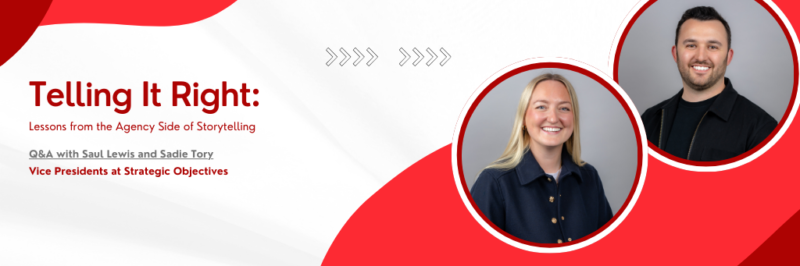
Telling It Right: Lessons from the Agency Side of Storytelling

800 266 Lois Marsh

Telling It Right: Lessons from the Agency Side of Storytelling

By Anmol Harjani

Every year on March 20, World Storytelling Day invites people around the world to celebrate the art of storytelling. For communicators, it’s more than a cultural moment, it’s a reminder of the responsibility we carry every day. Before campaigns and content calendars, stories were how we explained change, built trust and helped people understand what mattered.

To mark the day, I connected with Saul Lewis and Sadie Tory, Vice Presidents at Strategic Objectives, to talk about what storytelling looks like from the agency side today. Their perspectives reinforce a simple idea: storytelling is not embellishment. It is how strategy becomes real.

Saul Lewis

Vice President, Strategic Objectives

From an agency perspective, Saul sees storytelling as the bridge between business objectives and audience understanding. Strategy on its own can feel abstract. Storytelling is what makes it usable.

Facts inform, but stories influence,” he explains. Without a clear narrative, communications may generate attention, but they won’t necessarily generate impact.

He points to a major shift over the past decade: storytelling has moved from being campaign-driven to continuous and always on. Brands once relied heavily on traditional media moments. Today, narratives are shaped in real time by culture, creators, communities and constant digital dialogue.

That shift has changed expectations. Audiences no longer respond to messaging alone. They expect purpose to show up in behaviour. Authenticity and consistency are no longer competitive advantages, they are table stakes.

When asked what helps a story cut through, Saul returns to fundamentals: clarity, relevance and authenticity. If a story cannot be explained simply, it is likely too complicated. And if it does not connect to something people genuinely care about, it will not resonate.

His advice to communicators is practical. Start by listening. The strongest stories begin with what the audience cares about, not what the brand wants to say. Then simplify. Strip away jargon and focus on why the story matters. When words and actions align, credibility follows.

Sadie Tory

Vice President, Strategic Objectives

For Sadie, strong storytelling becomes especially critical when innovation is complex. She highlights the Canadian launch of Alexa+, powered by generative AI, as an example of storytelling functioning as translation.

The core innovation was largely invisible. It wasn’t a new device to showcase, but an evolution in intelligence. The challenge wasn’t just awareness, it was helping people understand how it would fit into their daily lives.

Instead of leading with technical specifications, the team built a narrative around everyday scenarios: managing a family schedule, planning a meal, navigating a busy morning. The focus shifted from showcasing technology to illustrating practical impact. The story became less about features and more about experience.

Tone was intentional. Because Alexa+ was in early access and still evolving, excitement was balanced with transparency. Limitations were acknowledged. The result extended beyond impressions. Media explained the product. Influencers demonstrated real use cases. Consumers were more willing to opt in because they could see themselves in the story.

Sadie emphasizes that authenticity requires discipline. Not every initiative is transformational, and not every launch is category-defining. Sometimes the most strategic move is narrowing the claim. Storytelling must be anchored in behaviour. If an organization cannot demonstrate its ambition through action, the narrative needs to be recalibrated.

Looking ahead, she sees storytelling becoming increasingly tied to leadership. As AI accelerates content production, the differentiator is no longer volume, it is coherence. Ensuring that CEO remarks, product launches, culture initiatives and crisis responses all reflect the same worldview is where real value lies.

Her advice to communicators is to look beyond the industry. Read fiction. Study long-form journalism. Pay attention to cultural shifts. Storytelling is less about polished language and more about clarity of thought. What changed? Why does it matter? Can you explain it simply?

What This Means for Communicators

Across both conversations, a clear theme emerges. Storytelling is not a layer added at the end of a campaign. It’s what ties a brand’s purpose, actions, and reputation together.

For communicators reflecting on World Storytelling Day, a few insights stand out:

  • Storytelling turns strategy into something people can understand and act on.

  • Continuous narrative matters more than one-off campaigns.

  • Clarity and relevance determine whether a story resonates.

  • Credibility is built through behaviour, not big claims.

  • Alignment across every touchpoint strengthens long-term trust.

World Storytelling Day is ultimately a reminder that storytelling has always shaped how we connect and lead. In communications, our role is to ensure that the stories we tell are grounded, coherent and reflective of real action. When strategy and story move together, influence follows.

Anmol Harjani is a Client Servicing Manager working with a remote company and a recent graduate of York University’s Public Relations and Communications program. She is especially interested in strategic communications, social media behaviour, and how PR practitioners adapt within a rapidly evolving digital landscape. She currently serves as the Communications Co-Chair on the CPRS Toronto Board.

Making Their Own Mark: How Freelancers Are Shaping the Future of Communications

800 1000 Lois Marsh

Making Their Own Mark:

How Freelancers Are Shaping the Future of Communications

By Anmol Harjani

Every year on March 13, National Freelancers Day celebrates the independence, creativity, and impact of professionals who are redefining what it means to have a communications career. No longer limited to traditional agency or in-house roles, independent and freelance practitioners are showing that autonomy, expertise, and strategic insight can flourish outside conventional career paths.

To mark the day, I connected with three communications professionals, Andrea Chrysanthou, Matt Celestial, and Gina Chung, who have embraced freelance work. Their stories illuminate the realities, challenges, and rewards of operating independently, while offering lessons in strategy, resilience and professional growth.

1. Andrea Chrysanthou, APR

Founder and Principal, Amplify Communications

Co-President, CPRS Toronto’s Board

Andrea has always loved the idea of building something of her own. Freelancing gave her the freedom to choose clients, define services, and set priorities. For Andrea, independence is about shaping work around values and expertise, rather than fitting into a pre-existing structure.

She notes that a common misconception is that freelance work is “easier” or requires less effort. In reality, her reputation and business depend on every client interaction. Almost all of her work comes from repeat clients or referrals, a testament to the trust and strategic value she delivers consistently.

Freelancing also requires a disciplined approach to vetting ideas and strategies. Without colleagues to bounce concepts off, Andrea takes extra time to consider alternative perspectives before presenting recommendations. Her advice to anyone considering freelance work is to protect themselves professionally, setting clear agreements and ensuring clients operate in good faith.

Through her LinkedIn group for Canadian communications freelancers, Andrea has also built a supportive space for peers to exchange ideas, share tools, and learn best practices, reinforcing her belief that community is key even in independent work.

2. Matt Celestial

Publicity Director, Animation & Interactive Entertainment

MCPR | A Statement Worldwide Company

Treasurer, CPRS Toronto’s Board

Matt’s path to freelancing was shaped by a mix of serendipity and long-held ambition. Initially considering psychology or medical school, a call from a former boss offered a different path, working independently rather than as an employee.

For Matt, the appeal of freelancing lies in the combination of entrepreneurial spirit and human connection. He relishes problem-solving for clients across sectors, and finds fulfillment in seeing people succeed. One memorable moment involved guiding a client through her first national television appearance, helping her feel confident and empowered and realizing that even small interventions can have a lasting impact.

He emphasizes that freelancing is not a temporary stopgap but a full business. Over ten years, Matt has navigated legal, accounting, finance, team management, and HR, skills that go far beyond traditional communications work. Listening, empathy, and authenticity form the core of how he builds credibility and sustains client relationships.

Matt encourages aspiring freelancers to embrace agility, invest in skill development, and even explore creative writing or content projects to hone their craft. And, most importantly, he reminds independent professionals to pause and enjoy the journey, even amidst busy or uncertain periods.

3. Gina Chung

Founder, Free Reign Media

Gina’s move into independent communications was rooted in her newsroom experience. Understanding how journalists evaluate stories, she now applies that editorial judgment to advising clients, focusing not just on coverage, but timing, positioning and story readiness.

One common misconception she encounters is that freelancing is less demanding. In reality, she wears every hat: strategy, execution, client management, and running a business. The responsibility is constant, but it also builds resilience and discipline. A defining moment for Gina was realizing that her business was sustainable, freelancing became a long-term platform for impact, relationships and autonomy.

Her advice for aspiring freelancers emphasizes mindset, discipline and initiative. Slow periods should be leveraged to build visibility, strengthen relationships, and uncover new opportunities for clients. Success is not accidental; it is intentional, strategic, and informed by foresight.

A Collective Portrait of Independent Communications Professionals

Across these three stories, a clear theme emerges. Freelancers in communications are not simply “between jobs”, they are leading with intention, building trust through demonstrated results, and shaping careers around autonomy, expertise and impact.

Key takeaways for professionals considering independent work:

  • Independence requires discipline, not less work.

  • Credibility is earned through consistency, foresight and integrity.

  • Freelancers must wear many hats while maintaining focus on strategy and execution.

  • Community and mentorship remain important, even when working solo.

  • Professional boundaries and business savvy are critical for sustainability.

National Freelancers Day is a celebration of independence, yes—but also of the professionals who are actively shaping the future of communications with strategic thinking, editorial judgment, and entrepreneurial spirit. Freelancers are no longer on the margins; they are redefining what it means to thrive in this field.

Anmol Harjani is a Client Servicing Manager working with a remote company and a recent graduate of York University’s Public Relations and Communications program. She is especially interested in strategic communications, social media behaviour, and how PR practitioners adapt within a rapidly evolving digital landscape. She currently serves as the Communications Co-Chair on the CPRS Toronto Board.