
Beyond the Title: Women in Communications on Leadership, Growth and Impact
By Anmol Harjani
Every year on March 8, International Women’s Day recognizes the achievements of women across industries and communities worldwide. It is a moment to celebrate progress, acknowledge challenges, and spotlight the voices shaping the future.
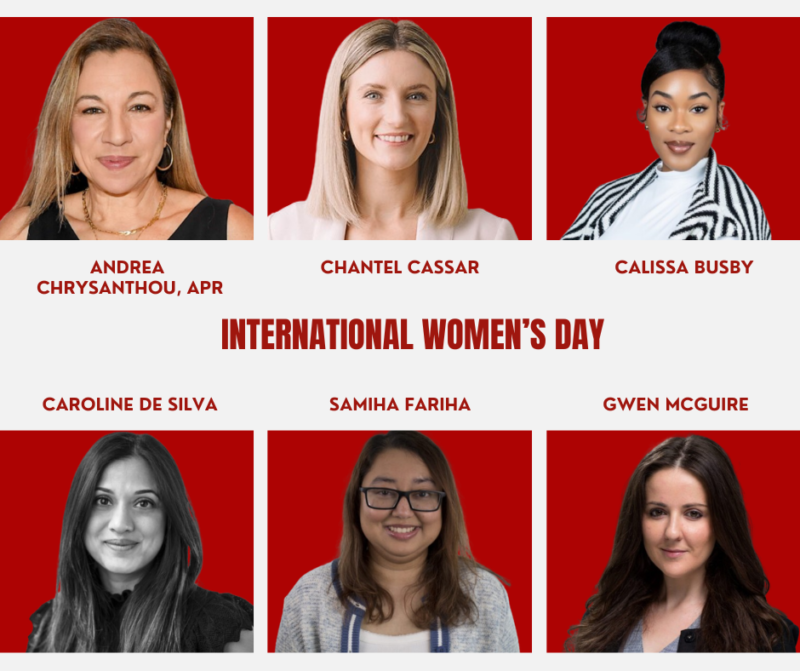
In communications, leadership does not follow a single path. It is built through strategic thinking, mentorship, resilience, creativity, and a willingness to evolve. To mark the occasion, I connected with six communications leaders, Andrea Chrysanthou, APR, Chantel Cassar, Calissa Busby, Caroline De Silva, Samiha Fariha, and Gwen McGuire, who are all members of the CPRS Toronto Board, to reflect on their journeys, the lessons they carry, and the impact they hope to leave behind.
What emerged is not just a series of individual stories, but a portrait of how women are defining leadership in their own ways.
1. Andrea Chrysanthou, APR

Founder and Principal, Amplify Communications
Co-President, CPRS Toronto’s Board
Andrea’s path into communications began in journalism. As a journalist and television producer, she worked closely with communications professionals and was drawn to the idea of shaping stories before they reached the public. As a storyteller herself, it felt like a natural pivot.
A defining milestone in her leadership journey was earning her APR designation. Without a formal communications education, the accreditation gave her theoretical grounding and the confidence to continue growing her career. She credits Monica Rossa, APR, as instrumental in guiding her through that process.
Andrea believes women bring strong multi-tasking abilities and emotional intelligence to communications leadership. The ability to prioritize, meet deadlines, and craft messaging that evokes emotion and engagement remains a powerful advantage in today’s landscape.
She acknowledges that women often face unique challenges, from balancing professional and domestic expectations to navigating age-related bias. These realities have influenced how she leads, encouraging collaboration, openness, and the courage to ask questions. For her, leadership is about continuous learning. In 2026 and beyond, meaningful leadership means anticipating change, particularly around AI and evolving technologies, and adapting before becoming irrelevant.
Her advice to young women: build a network of professionals who will champion you, just as you champion them. Those relationships, she says, are invaluable to both career growth and personal resilience.
2. Chantel Cassar

Co-Founder, Category Communications
Corporate Community Chair, CPRS Toronto’s Board
Chantel’s career began in experiential marketing, where she worked with brands to bring experiences to life. The intersection of creativity, storytelling, and strategy naturally led her to public relations. With a background in sociology and psychology, she has always been fascinated by what makes people pay attention, trust, and connect.
What keeps her in communications is its constant evolution. From shifting platforms to the rise of AI and Answer Engine Optimization (AEO), the industry demands adaptability and curiosity.
Rather than a single defining moment, Chantel’s leadership style has been shaped by working alongside strong female leaders and absorbing lessons from each experience. She believes women bring emotional intelligence, empathy, and relational awareness to leadership — qualities essential in navigating nuance and managing complex stakeholder relationships.
Having experienced imposter syndrome herself, she is intentional about mentoring young professionals. She often reminds them not to let their own minds become barriers, reinforcing encouragement with specific, constructive feedback.
Today, her approach to decision-making is grounded in decisiveness and accountability. Instead of overanalyzing outcomes, she focuses on making decisions and ensuring they succeed through follow-through. For Chantel, meaningful leadership in 2026 will centre on care and consistency — caring deeply about people and the work, and showing up for both every day.
3. Calissa Busby

Account Coordinator, Kaiser & Partners
Membership Director, CPRS Toronto’s Board
Calissa was drawn to communications by the power of storytelling and its ability to shift perception and create opportunity. As an international student moving from St. Maarten to Toronto, she experienced firsthand how communication opens doors.
A defining leadership moment came when she became President of the CPRS Student Steering Committee in 2023. It was the first time she saw herself not only participating in the industry, but helping shape it. Mentors including Anne Marie Males, Ted Bravakis, and Eileen Tobey helped her recognize her potential and step confidently into leadership.
She believes women bring emotional intelligence and collaboration to communications leadership — strengths that foster authenticity and cultural awareness.
Navigating the industry as a young international professional sometimes meant proving herself twice. Those experiences shaped her mentorship style, ensuring emerging communicators, particularly from underrepresented backgrounds, feel seen and supported.
Today, she approaches leadership through alignment and impact rather than pure execution. Meaningful leadership, she says, must be inclusive, rooted in integrity, and grounded in values even amid rapid change.
Her advice to young women: be confident in your voice early. You do not need to wait for a title to lead.
4. Caroline De Silva

Senior Vice President, Consumer Health & Lifestyle, ChangeMakers
Board Operations Director, CPRS Toronto’s Board
Caroline thrives in fast-paced environments where communication sits at the heart of organizational purpose. Consumer PR, with its intersection of culture, business, and human behaviour, feels like home.
She credits mentors who encouraged bold thinking and challenged established playbooks. That influence shaped her belief that leadership means questioning assumptions and backing brave ideas.
Women, she believes, bring emotional intelligence, resilience, and instinct rooted in experience. The ability to read nuance, build trust, and follow informed intuition is a powerful leadership asset.
Like many women, she has felt pressure to over-deliver to prove credibility. While that instilled discipline and preparation, it also reinforced the importance of pacing and long-term perspective.
Earlier in her career, she measured success by speed and output. Today, she focuses on impact and intentionality. Not everything deserves urgency. Sustainable success comes from doing the right things exceptionally well.
Meaningful leadership, she says, shapes cultures where people feel trusted, challenged, and inspired to exceed their own potential.
5. Samiha Fariha

Senior Associate, Golin
Professor, The G. Raymond Chang School of Continuing Education at Toronto Metropolitan University
Communications Chair, CPRS Toronto’s Board
Samiha was initially drawn to communications by the excitement of pitching stories in a fast-paced agency environment. Over time, what sustained her passion was the variety and impact of the work, as well as the relationships built with journalists, influencers, and colleagues.
Leadership for her has been shaped by managers and peers who believed in her potential early on. Those experiences reinforced that leadership is about lifting others while delivering results.
She believes women bring empathy, collaboration, and the ability to read nuance — strengths that support thoughtful decision-making and stronger teams.
Moments of self-doubt early in her career influenced her approach to mentorship. She now leads with transparency and encouragement, creating space for others to ask questions and grow without fear.
Today, her leadership style emphasizes context and inclusion in decision-making. Rather than prioritizing speed alone, she ensures teams understand the “why” behind decisions.
Looking ahead, meaningful leadership will require presence, listening, and a strong investment in developing the next generation.
6. Gwen McGuire

Director of Communications, Starlight Investments
Secretary, CPRS Toronto’s Board
Gwen was drawn to communications by its power to shape perception and influence decisions. The strategic element of helping organizations articulate who they are and what they stand for continues to motivate her.
Leaders who trusted her early and encouraged her to step outside her comfort zone shaped her leadership philosophy. Today, she strives to extend that same trust and stretch opportunities to others.
Women bring empathy, strategic intuition, and an ability to read nuance, she says — all critical in building high-performing teams and thoughtful communications strategies.
Experiences where her voice was not immediately heard strengthened her resolve to ensure others feel seen and supported. She is intentional about creating environments where everyone has space to contribute.
Earlier in her career, she felt pressure to provide immediate answers. Now, she prioritizes asking better questions and creating clarity and alignment. For Gwen, meaningful leadership in 2026 and beyond is grounded in transparency, empathy, purpose, and lifting others as you lead.
A Collective Reflection on Leadership
Across these conversations, common themes emerge.
Meaningful leadership is not about perfection or authority. It is about continuous learning, emotional intelligence, collaboration, and courage. It is about asking questions, embracing change, and building cultures where others can thrive.
In a profession defined by storytelling, these women demonstrate that the most powerful narratives are not just external campaigns, but the internal cultures we create and the people we elevate along the way.
International Women’s Day is a moment to celebrate progress, but also to reaffirm a responsibility: to lead with purpose, to mentor intentionally, and to shape a communications industry that is resilient, inclusive, and ready for what comes next.
Anmol Harjani is a Client Servicing Manager working with a remote company and a recent graduate of York University’s Public Relations and Communications program. She is especially interested in strategic communications, social media behaviour, and how PR practitioners adapt within a rapidly evolving digital landscape. She currently serves as the Communications Co-Chair on the CPRS Toronto Board.