
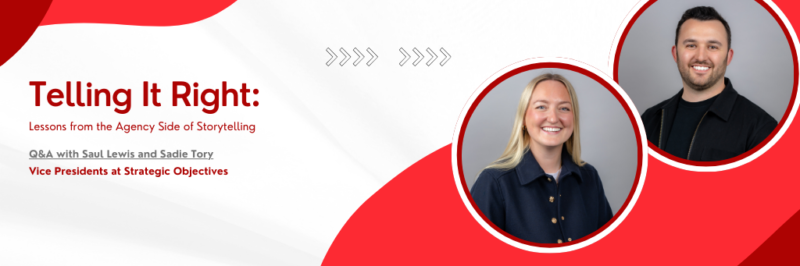
Telling It Right: Lessons from the Agency Side of Storytelling
By Anmol Harjani
Every year on March 20, World Storytelling Day invites people around the world to celebrate the art of storytelling. For communicators, it’s more than a cultural moment, it’s a reminder of the responsibility we carry every day. Before campaigns and content calendars, stories were how we explained change, built trust and helped people understand what mattered.
To mark the day, I connected with Saul Lewis and Sadie Tory, Vice Presidents at Strategic Objectives, to talk about what storytelling looks like from the agency side today. Their perspectives reinforce a simple idea: storytelling is not embellishment. It is how strategy becomes real.
 Saul Lewis
Vice President, Strategic Objectives
From an agency perspective, Saul sees storytelling as the bridge between business objectives and audience understanding. Strategy on its own can feel abstract. Storytelling is what makes it usable.
“Facts inform, but stories influence,” he explains. Without a clear narrative, communications may generate attention, but they won’t necessarily generate impact.
He points to a major shift over the past decade: storytelling has moved from being campaign-driven to continuous and always on. Brands once relied heavily on traditional media moments. Today, narratives are shaped in real time by culture, creators, communities and constant digital dialogue.
That shift has changed expectations. Audiences no longer respond to messaging alone. They expect purpose to show up in behaviour. Authenticity and consistency are no longer competitive advantages, they are table stakes.
When asked what helps a story cut through, Saul returns to fundamentals: clarity, relevance and authenticity. If a story cannot be explained simply, it is likely too complicated. And if it does not connect to something people genuinely care about, it will not resonate.
His advice to communicators is practical. Start by listening. The strongest stories begin with what the audience cares about, not what the brand wants to say. Then simplify. Strip away jargon and focus on why the story matters. When words and actions align, credibility follows.
 Sadie Tory
Vice President, Strategic Objectives
For Sadie, strong storytelling becomes especially critical when innovation is complex. She highlights the Canadian launch of Alexa+, powered by generative AI, as an example of storytelling functioning as translation.
The core innovation was largely invisible. It wasn’t a new device to showcase, but an evolution in intelligence. The challenge wasn’t just awareness, it was helping people understand how it would fit into their daily lives.
Instead of leading with technical specifications, the team built a narrative around everyday scenarios: managing a family schedule, planning a meal, navigating a busy morning. The focus shifted from showcasing technology to illustrating practical impact. The story became less about features and more about experience.
Tone was intentional. Because Alexa+ was in early access and still evolving, excitement was balanced with transparency. Limitations were acknowledged. The result extended beyond impressions. Media explained the product. Influencers demonstrated real use cases. Consumers were more willing to opt in because they could see themselves in the story.
Sadie emphasizes that authenticity requires discipline. Not every initiative is transformational, and not every launch is category-defining. Sometimes the most strategic move is narrowing the claim. Storytelling must be anchored in behaviour. If an organization cannot demonstrate its ambition through action, the narrative needs to be recalibrated.
Looking ahead, she sees storytelling becoming increasingly tied to leadership. As AI accelerates content production, the differentiator is no longer volume, it is coherence. Ensuring that CEO remarks, product launches, culture initiatives and crisis responses all reflect the same worldview is where real value lies.
Her advice to communicators is to look beyond the industry. Read fiction. Study long-form journalism. Pay attention to cultural shifts. Storytelling is less about polished language and more about clarity of thought. What changed? Why does it matter? Can you explain it simply?
What This Means for Communicators
Across both conversations, a clear theme emerges. Storytelling is not a layer added at the end of a campaign. It’s what ties a brand’s purpose, actions, and reputation together.
For communicators reflecting on World Storytelling Day, a few insights stand out:
-
Storytelling turns strategy into something people can understand and act on.
-
Continuous narrative matters more than one-off campaigns.
-
Clarity and relevance determine whether a story resonates.
-
Credibility is built through behaviour, not big claims.
-
Alignment across every touchpoint strengthens long-term trust.
World Storytelling Day is ultimately a reminder that storytelling has always shaped how we connect and lead. In communications, our role is to ensure that the stories we tell are grounded, coherent and reflective of real action. When strategy and story move together, influence follows.
Anmol Harjani is a Client Servicing Manager working with a remote company and a recent graduate of York University’s Public Relations and Communications program. She is especially interested in strategic communications, social media behaviour, and how PR practitioners adapt within a rapidly evolving digital landscape. She currently serves as the Communications Co-Chair on the CPRS Toronto Board.